Beyond K-Pop and K-Food: The Rise of ‘K-Donation’
The World Should Watch Korea’s Philanthropic Policy… A 'Digital Revolution of Sharing' Combining IT and Civic Consciousness
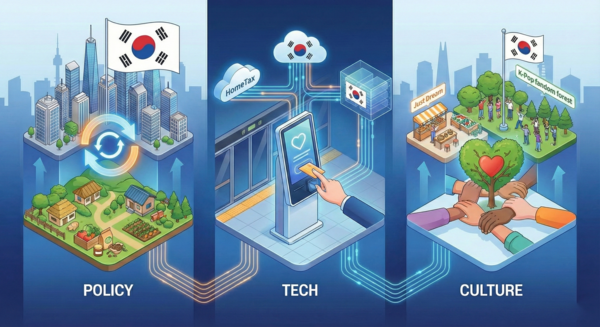
① [Policy] A Creative Solution to Regional Depopulation: The 'Hometown Love Donation System' ② [Tech] Donating in 3 Seconds While Renewing a Passport? World-Class 'Digital Administrative Integration' ③ [Culture] Fandoms Planting Forests and Saving Restaurants… Korea’s Unique Culture of 'Solidarity'
The world is fascinated by Korean music (K-Pop) and food (K-Food). However, a more remarkable 'evolution of systems' is occurring within Korean society. It is 'K-Donation (The Korean Model of Giving).'
Korea has successfully interpreted the analog value of 'sharing' through world-class 'IT technology' and unique 'public policies.' This case offers a new alternative to many nations facing welfare blind spots and donation fatigue.
◆ 1. Finding a Solution to Regional Extinction in Donation: 'Hometown Love Donation System'
Korea's 'Hometown Love Donation System' is not merely a fundraising campaign. It is a sophisticated economic policy designed to solve the problem of 'regional extinction' caused by rapid urbanization.
The core of this system is 'circulation.' City dwellers donate money to rural areas and receive tax benefits. Local governments use the funds to expand welfare for residents. Furthermore, donors receive local specialty products (return gifts) from the region, revitalizing the local economy.
While Western philanthropy often relies on individual charity, K-Donation is evaluated as a policy innovation in that the state has created a system (tax benefits + local economy) to maximize the efficacy of donations. From 2026, the introduction of 'Designated Donations' allows donors to directly participate as agents solving specific regional issues, such as attracting pediatric clinics or regenerating empty houses.
◆ 2. The Face of an IT Powerhouse: Hyper-connectivity of 'Administrative Data' and 'Donation'
The greatest competitive edge of the Korean donation system is 'transparency' and 'convenience.' This is made possible by Korea's powerful E-Government infrastructure.
In Korea, donors do not need to collect paper receipts. The moment a donation is made, the details are automatically transmitted to 'HomeTax,' the National Tax Service (NTS) database, and tax refunds are processed via a one-stop system at the end of the year.
The 'Donation Kiosks' recently introduced in major municipalities, including Gyeonggi Province, represent the pinnacle of this technology. Citizens donate by tagging their cards at city halls or subway stations, just like buying a coffee. Complex paperwork has vanished, and the flow of donation funds is disclosed transparently, much like blockchain. "Administrative costs (Red tape) near zero, donation delivery at the speed of light" — this is the technological goal of K-Donation.
◆ 3. Welfare Experiment Based on Trust: 'Just Dream' & 'Good Influence'
K-Donation is completed by overlaying Korea's unique culture of 'Jeong (deep affection/attachment)' onto policy and technology.
The 'Just Dream' store, operating in cities like Hwaseong, is a food market where anyone can take food without proof documents. It overturns the paradigm of existing welfare systems that say, "Prove your poverty to receive benefits," and operates based on the trust capital of "believing in the conscience of citizens." Surprisingly, this system has created a virtuous cycle where those who received help later restock the items, rather than leading to abuse.
In addition, the 'Don-Jjul (Scolding with Money)' culture, where citizens line up to boost sales for restaurants that provide free meals to underfed children, and 'K-Pop Fandom Charity,' where fans donate rice and forests in the name of stars, are dynamic, citizen-led forms of sharing found only in Korea.
◆ Why the World Should Learn K-Donation
In 2026, Korea has redefined donation not as a 'special sacrifice' but as a 'smart lifestyle.'
- Sophisticatedly designed Policy
- Transparent and fast Technology
- Culture of trusting and helping one another
These three elements combine to form K-Donation. Facing global challenges of wealth gaps and the collapse of communities, Korea's warm and smart system is becoming a new 'Global Standard for Sharing.'