COVID-19 Arrived and Donations Fell: Korean Corporate Giving Dropped 17% Two Years Later
Total donations declined in 2020 for the first time since records began
Individual giving rose through the pandemic while corporate giving peaked and fell
People often say giving rises when disaster strikes. Korea's numbers say otherwise.
National Tax Service donation statistics
Down in the first year of the crisis
In 2020, when COVID-19 began, Korea's total donations fell for the first time since statistics were compiled. It runs against intuition: in a year when masks sold out, hospital beds ran short and news of donations filled the headlines, the money actually collected was lower than the year before.
Giving comes from income
The reason is not that generosity cooled. Donations come from income, and when income wavers, so does giving. In a year when small businesses lost sales and corporate earnings plunged, it would have been strange for total giving to hold up. Disaster calls for giving but also cuts the capacity to give, and in 2020 the second force was stronger.
The peak came in the second year
Donations peaked in 2021 at a record 15.6 trillion won, a year after the worst of the crisis, as emergency budgets were spent and earnings recovered. Giving reacts to disasters with a lag.
Then companies pulled back
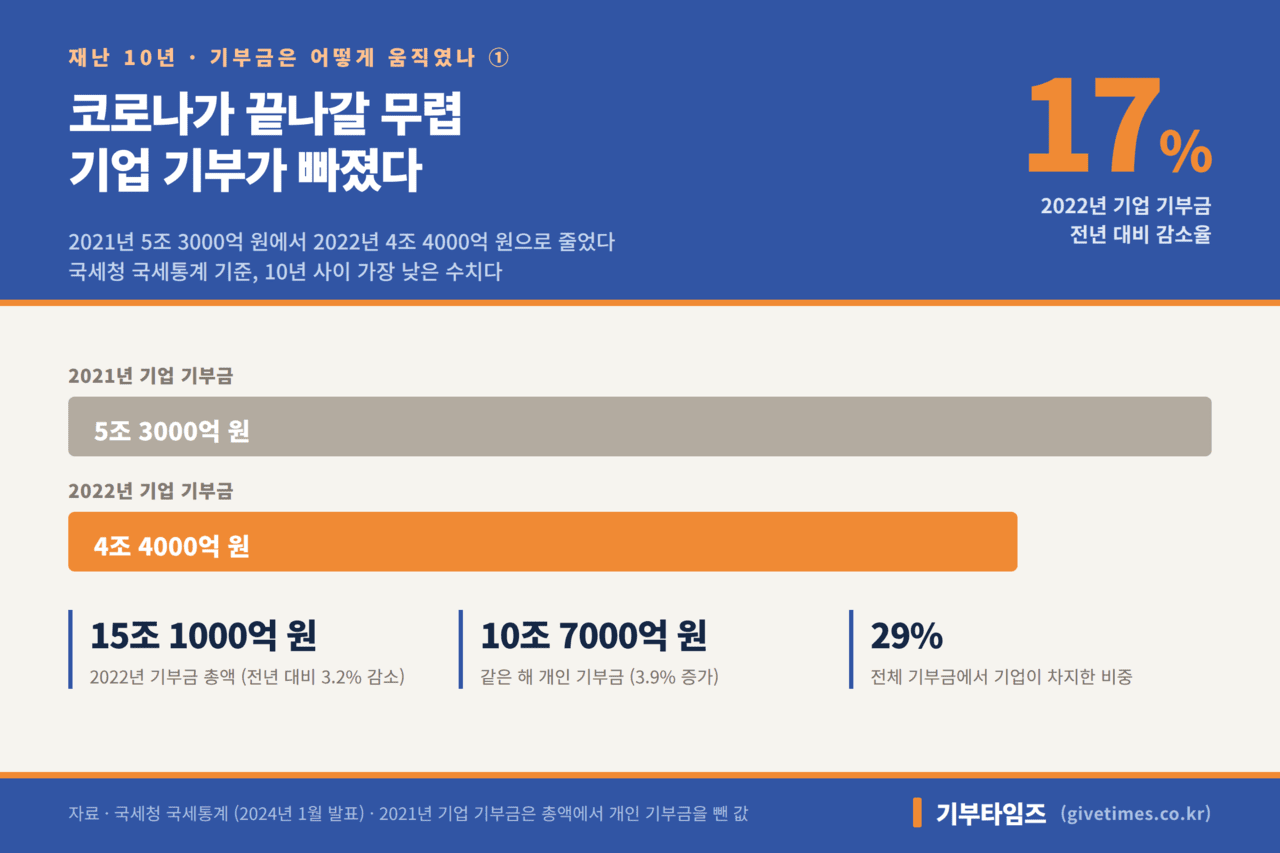
In 2022 corporate donations fell to 4.4 trillion won from 5.3 trillion won, a drop of 900 billion won or 17% and the lowest in a decade. Total giving fell 500 billion won to 15.1 trillion won. Individuals increased their giving by 400 billion won, offsetting part of the corporate decline.
This is an English edition of a Give Times report first published in Korean on August 25, 2026. Read the original: 코로나가 왔는데 기부금은 줄었다… 기업 기부는 2년 뒤 17% 급감