Korea Will Vary Hometown Donation Tax Credits by Region from 2027, Favouring the Places Furthest from Seoul
The 2026 tax reform bill splits recipient areas into four bands and raises the credit for the most disadvantaged
On a 500,000 won gift the credit rises from 193,500 won to 237,500 won, a difference of 44,000 won
44,000 won · the extra credit on a 500,000 won gift to a preferential area once the change takes effect
Korea's 2026 tax reform bill (announced August 2026, government version confirmed 1 September 2026). Regional differentiation of the hometown donation tax credit, applying to gifts made on or after 1 January 2027
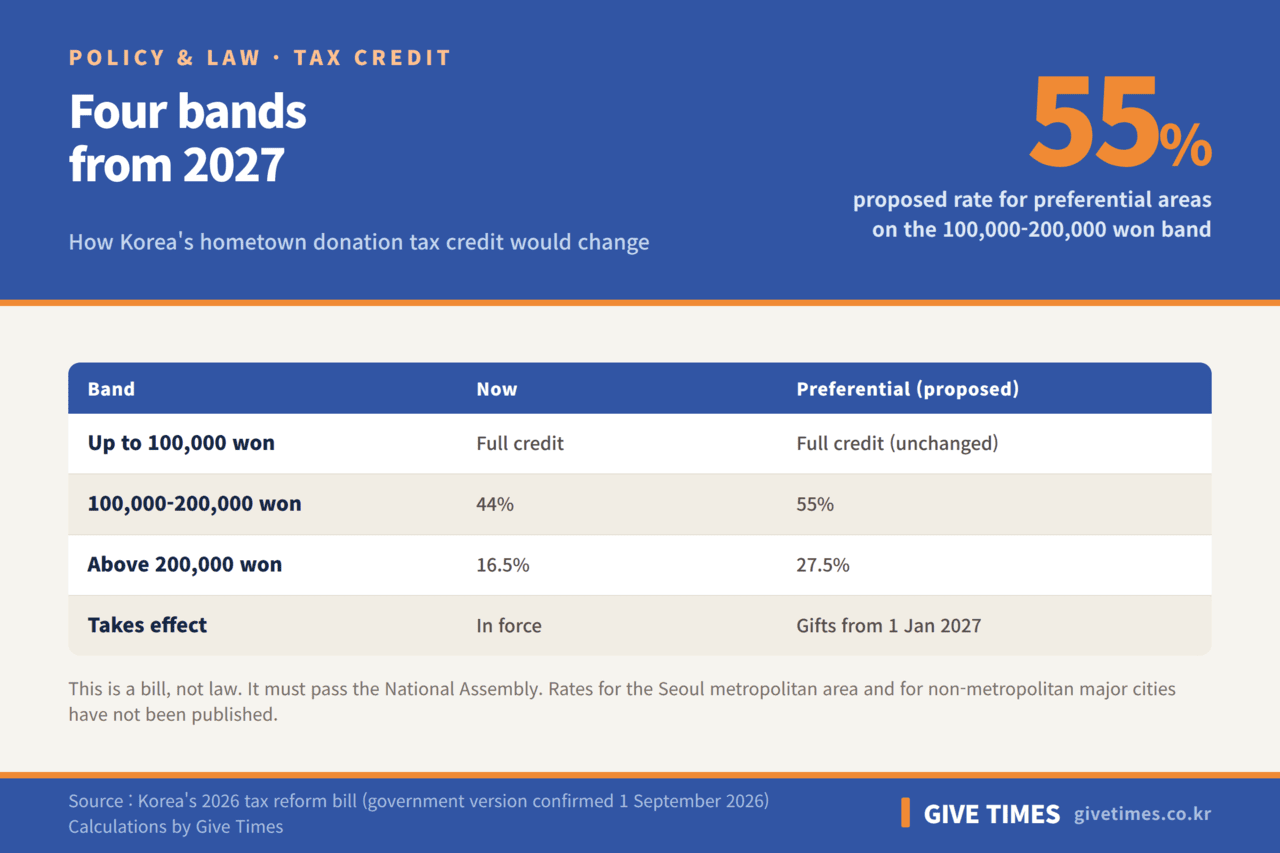
Current rates : full credit up to 100,000 won; 44% on the band from 100,000 to 200,000 won; 16.5% above 200,000 won
Four proposed bands : Seoul metropolitan area / non-metropolitan major cities / other non-metropolitan areas / preferential non-metropolitan areas
Proposed rates for preferential areas : 55% on the 100,000 to 200,000 won band, 27.5% above 200,000 won
Annual donation ceiling 20 million won; thank-you gifts capped at 30% of the donation
Preferential areas are to be defined in the Enforcement Decree of the Restriction of Special Taxation Act, weighing distance from Seoul and local population, economic and social conditions
Current credit on 500,000 won = 100,000 + (100,000 × 44%) + (300,000 × 16.5%) = 193,500 won
Proposed credit in a preferential area = 100,000 + (100,000 × 55%) + (300,000 × 27.5%) = 237,500 won
Increase 44,000 won, or 22.7%
Gift ceiling 150,000 won = 500,000 × 30%
Net outlay 112,500 won = 500,000 - 237,500 - 150,000
This is a bill, not law. It must pass the National Assembly before it takes effect
No preferential areas have been named. The Enforcement Decree will define them
The rates for the other three bands · how many areas will qualify as preferential
Revenue impact estimates · whether the 150,000 won gift ceiling is annual or per gift
From January 2027 the tax credit for a hometown donation in Korea would depend on where the money goes.
The 2026 tax reform bill divides recipient areas into four bands: the Seoul metropolitan area, non-metropolitan major cities, other non-metropolitan areas, and preferential non-metropolitan areas.
For a preferential area, a gift of 500,000 won would earn a credit of 237,500 won instead of the present 193,500 won. That is 44,000 won more, or about 31 US dollars at 1,400 won to the dollar. Give Times did the arithmetic.
Ten percent back in full, then two brackets
Under the present rules the first 100,000 won of a hometown donation is credited in full, the band from 100,000 to 200,000 won at 44%, and anything above 200,000 won at 16.5%.
The rate is the same wherever the money goes. Because the first 100,000 won comes back in full, a large share of Korean hometown giving has clustered at exactly that amount.
The annual ceiling is 20 million won, and donors may receive thank-you gifts worth up to 30% of what they gave.
The bill leaves the first bracket alone. What changes is the two brackets above it.
From 2027 the country splits into four
The bill sorts recipient areas into four bands and sets a different credit rate for each.
Only the preferential band's rates have been published. The 100,000 to 200,000 won band rises from 44% to 55%, and the band above 200,000 won from 16.5% to 27.5%. Those are 1.25 and 1.67 times the current rates.
What the other three bands get is not stated in the material Give Times could obtain. Whether the Seoul metropolitan area keeps its current rate or loses ground changes the character of the whole scheme, so the paper has asked the Ministry of Economy and Finance for those figures.
One point needs stating plainly. This is a bill. It takes effect only if the National Assembly passes it, and only for gifts made on or after 1 January 2027.
Running the numbers on 500,000 won
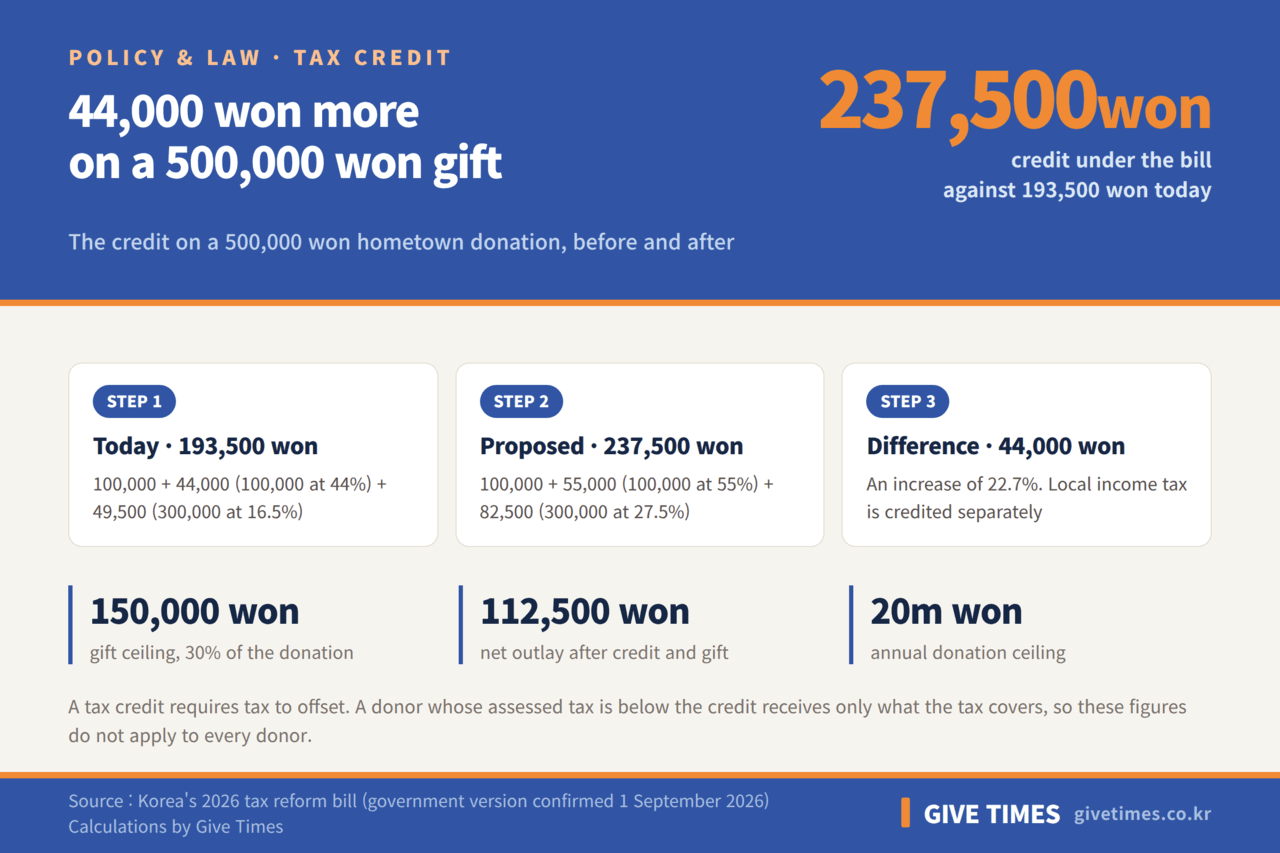
A 500,000 won gift to a preferential area would earn 237,500 won in credit, against 193,500 won today.
Today's sum works like this. The first 100,000 won is credited in full. The next 100,000 won at 44% gives 44,000 won. The remaining 300,000 won at 16.5% gives 49,500 won. Together, 193,500 won.
Under the bill the first 100,000 won is unchanged, the next 100,000 won at 55% gives 55,000 won, and the remaining 300,000 won at 27.5% gives 82,500 won. Together, 237,500 won.
The difference is 44,000 won, an increase of 22.7%.
These figures exclude local income tax, which is credited separately.
The list does not exist yet
No area has been designated as preferential. The Enforcement Decree of the Restriction of Special Taxation Act will set the criteria.
What is known is what the government says it will weigh: distance from Seoul, and local population, economic and social conditions. Nothing more specific has been published.
Give Times does not guess at which counties will qualify. Readers planning a gift for the higher rate will have to wait for the decree.
Add the thank-you gift and the arithmetic shifts again. At 30% of 500,000 won, the gift is worth up to 150,000 won. Credit and gift together come to 387,500 won, leaving a net outlay of 112,500 won. But the gift is produce and local goods, not cash, and a credit only helps a donor who owes enough tax to absorb it.
Frequently asked questions
How much tax credit do you get for a hometown donation in Korea?
Today, the first 100,000 won in full, 44% on the band up to 200,000 won, and 16.5% above that, plus a separate local income tax credit.
What changes in 2027?
Recipient areas split into four bands with different rates. Preferential areas would get 55% on the 100,000 to 200,000 won band and 27.5% above 200,000 won. The bill must pass the National Assembly first.
Which regions get the higher rate?
None has been named. The Enforcement Decree will define preferential areas by distance from Seoul and by local population, economic and social conditions.
What gift can a hometown donor receive?
Up to 30% of the donation in local produce and goods. On a 500,000 won gift that is up to 150,000 won, paid in kind rather than cash.
Can a foreign resident give?
This article did not establish that. Give Times has put the question to the Ministry of the Interior and Safety and will report the answer separately.
What is still missing
Give Times has asked the Ministry of Economy and Finance for the rates applying to the other three bands, the criteria and expected number of preferential areas, the decree timetable, and the revenue impact estimate.
Whether the 150,000 won gift ceiling is an annual or a per-gift limit was not established.
Sources
Korea's 2026 tax reform bill (Ministry of Economy and Finance, announced August 2026; government version confirmed 1 September 2026). Regional differentiation of the hometown donation tax credit from 1 January 2027. Four bands: Seoul metropolitan area, non-metropolitan major cities, other non-metropolitan areas, preferential non-metropolitan areas. Preferential rates 55% and 27.5%. Criteria to be set in the Enforcement Decree of the Restriction of Special Taxation Act.
Current hometown donation tax credit. Full credit to 100,000 won, 44% to 200,000 won, 16.5% above. Annual ceiling 20 million won, thank-you gifts up to 30%.
Korean press reports, 9 and 10 August 2026. A Seoul resident giving 500,000 won to a preferential area: about 193,500 won today, about 237,500 won under the bill.
Give Times calculations
193,500 won is 100,000 plus 44,000 plus 49,500. 237,500 won is 100,000 plus 55,000 plus 82,500.
The difference of 44,000 won is 22.7% of 193,500 won.
The gift ceiling of 150,000 won is 30% of 500,000 won.
The net outlay of 112,500 won is 500,000 less the 237,500 credit and the 150,000 gift.
How to read these numbers
Give Times attaches this section to every article. How a number should be read matters as much as the number itself.
This is a bill, not law. Gifts made now are credited at the present rates.
No area has been designated preferential. Nothing here says which places will qualify.
The figures exclude local income tax, which is credited separately, and a tax credit requires tax to offset. A donor whose assessed tax is below the credit receives only what the tax covers, so these figures do not apply to every donor.
Dollar equivalents are given at 1,400 won to the dollar for readability only. They are not a verified exchange rate for any particular date.