Seven in 10 of Korea's Bottom Earners Stayed There a Year Later, and 87.8% of Those 65 and Older
Of people in the bottom 20% of earners in Korea in 2023, 70.7% were still there in 2024, according to income mobility statistics released by the national statistics agency on Oct. 29
Among people aged 65 and older, 87.8% stayed in the bottom group. The statistics cover earned and business income only, excluding pensions and other transfers
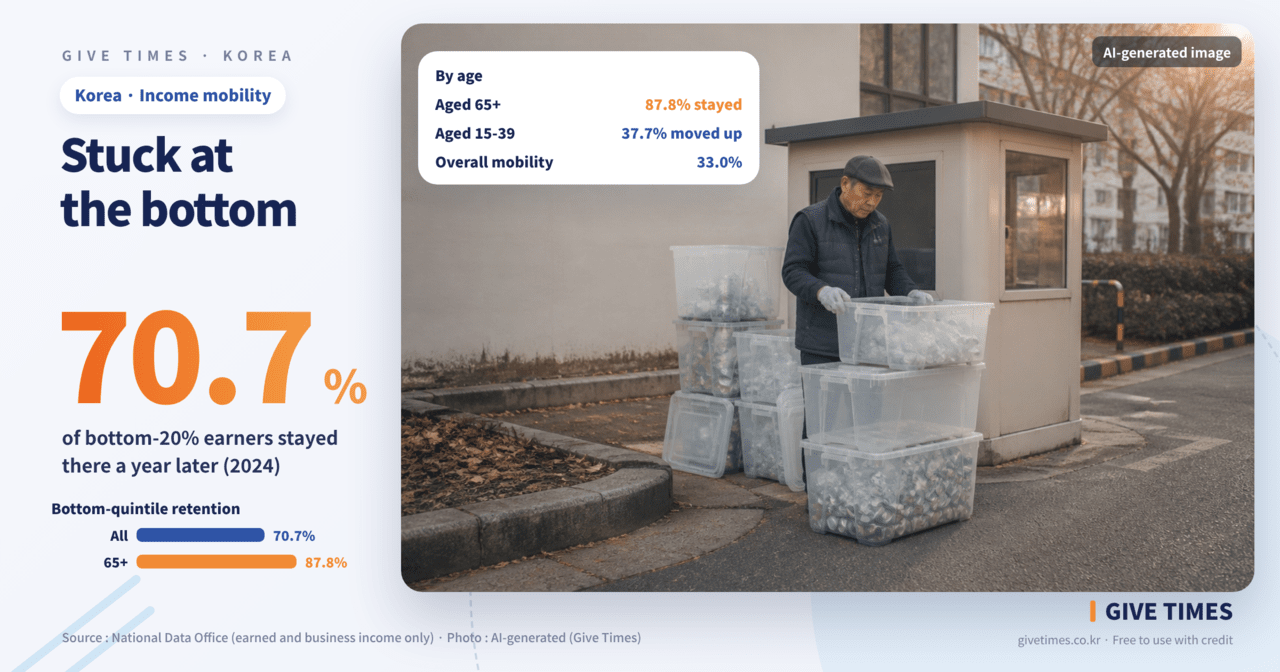
The share who stayed in the bottom quintile rose 0.6 percentage points to 70.7%. Overall income mobility, the share who moved to a different quintile, fell 1.2 points to 33.0%, with 16.9% moving up and 16.1% moving down.
Older people stuck at the bottom
Among those aged 65 and older, 87.8% of bottom-quintile earners stayed there, the highest of any age group, and only 12.2% moved up. The share of older people in the bottom quintile rose from 42.3% to 44.1%. Among those aged 15 to 39, 37.7% left the bottom quintile.
What the numbers measure
The statistics track individual pre-tax earned and business income from tax records for about 28.5 million people with income in both 2023 and 2024. Pensions, other transfers and property income are excluded, so the bottom quintile does not necessarily mean poverty.
70.7% · share of Korea's bottom 20% of earners who stayed there a year later, 2024 (87.8% for those 65+)
National Data Office, 2024 income mobility statistics press release (Oct. 29, 2026)
Exit rate = 100% − 70.7% = 29.3%
Young vs. older exit rate = 37.7% ÷ 12.2% ≈ 3.1 times
Income covers only pre-tax earned and business income; transfers and property income are excluded
If you find an error, please contact press@givetimes.co.kr.