Korea Plans to Raise Its Livelihood Benefit Line to 35% of Median Income by 2030
A draft of Korea's fourth Basic Livelihood Security Plan (2027-2029) proposes raising the livelihood benefit threshold from 32% to 35% of standard median income by 2030
Researchers estimate about 990,000 people qualify for livelihood or medical benefits but do not receive them
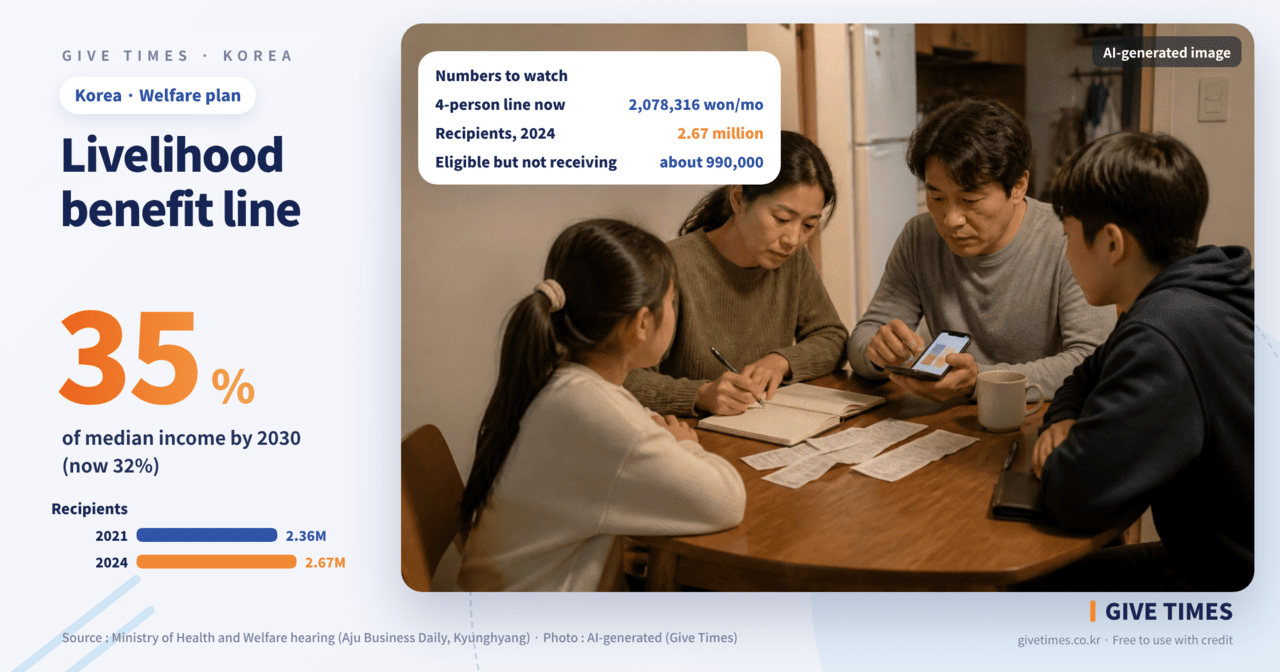
The current threshold equals 2,078,316 won a month for a four-person household this year. Kim Tae-wan, a senior research fellow at the Korea Institute for Health and Social Affairs, presented 16 core tasks, including raising the housing benefit line from 48% to 50% and easing how cars and homes are counted as income.
People left outside
Recipients of basic livelihood security rose from 2.36 million in 2021 to 2.67 million in 2024. Researchers estimate about 990,000 people who meet the criteria for livelihood or medical benefits still do not receive them. The plan would also phase out the family support obligation test, starting with people with severe disabilities.
Next steps
The draft is a research proposal, not a final plan. The ministry said it will review comments and put the plan to the Central Living Security Committee in November.
35% · proposed livelihood benefit threshold by 2030 (currently 32% of standard median income)
Aju Business Daily, public hearing on the 4th Basic Livelihood Security Plan (Oct. 28, 2026)
Kyunghyang Shinmun, same hearing (Oct. 28, 2026)
Recipient increase = 2.67 million − 2.36 million = 310,000
The plan is a research draft and has not been finalized
The estimate of people outside the system varies by definition (650,000 to 990,000)
If you find an error, please contact press@givetimes.co.kr.