Korea's Poorest Seniors Need 3.1 Trillion Won a Year for Long-Term Care, and the State Pays None of It
Long-term care costs for Korea's poorest seniors reached 3.12 trillion won in 2025, up 71% in five years, and are paid entirely by local governments
The same seniors get 80% national funding when treated in a hospital. Separately, food and household goods donated to food banks reached 260.8 billion won in 2025
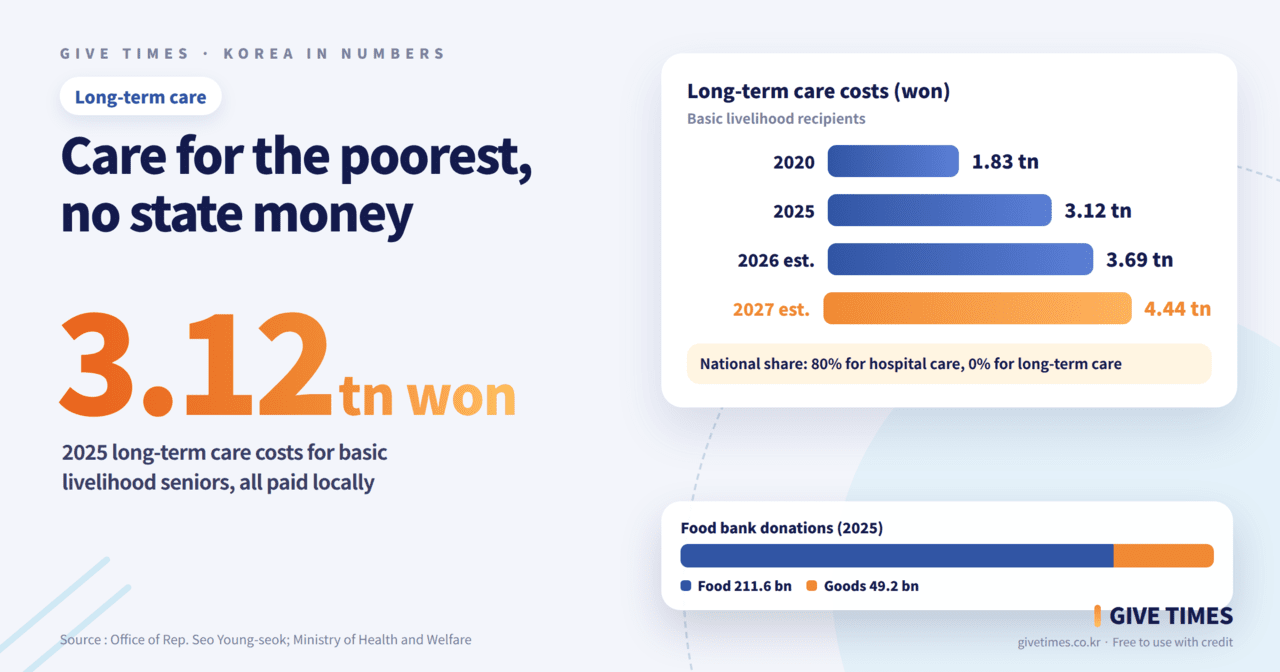
When these seniors are treated in a hospital, the national government covers 80% of the cost (50% in Seoul). When they use nursing homes or home care, it pays nothing. The legal basis for national support disappeared when a dedicated grant was folded into general local grants in 2015.
Costs keep climbing
The cost rose from 1.83 trillion won in 2020 to 3.12 trillion won in 2025, while users grew from 120,000 to 177,000. The health ministry projects 4.44 trillion won in 2027. Gyeonggi Province and its 31 cities and counties alone will pay 930.1 billion won in 2026, a quarter of the national local burden. Four provinces, including Seoul and Gyeonggi, could not pay their full share in 2025. The ministry said it had not reviewed the cost of national funding.
Food bank donations rise
Food and household goods donated to Korea's food banks and food markets reached 260.8 billion won in 2025, up 62.1% from 2015, according to the Ministry of Health and Welfare. Donors, including companies, rose 54.8% to 25,440. Some 439 centers served 343,919 individuals and groups. October 16 is World Food Day.
3.12 trillion won · 2025 long-term care costs for basic livelihood recipients, paid entirely by local governments
Office of Rep. Seo Young-seok, Ministry of Health and Welfare data (as reported by Welfare News, October 7, 2026)
Gyeonggi Province (as reported by The Korea Economic Daily, September 29, 2026)
Ministry of Health and Welfare, food bank program results (as reported by Munhwa Today, September 25, 2026)
Five-year increase = (3.12 trillion − 1.83 trillion) ÷ 1.83 trillion = 70.7%
Food bank donation increase = (260.8 billion − 160.9 billion) ÷ 160.9 billion = 62.1%
2026 and 2027 figures are ministry projections
Basic livelihood recipients and all medical aid recipients are different groups
If you find an error, please contact press@givetimes.co.kr.