Korea's Integrated Care Drew 93,000 Applicants in Five Months, but Linkage Rates Ranged From 23.7% to 95%
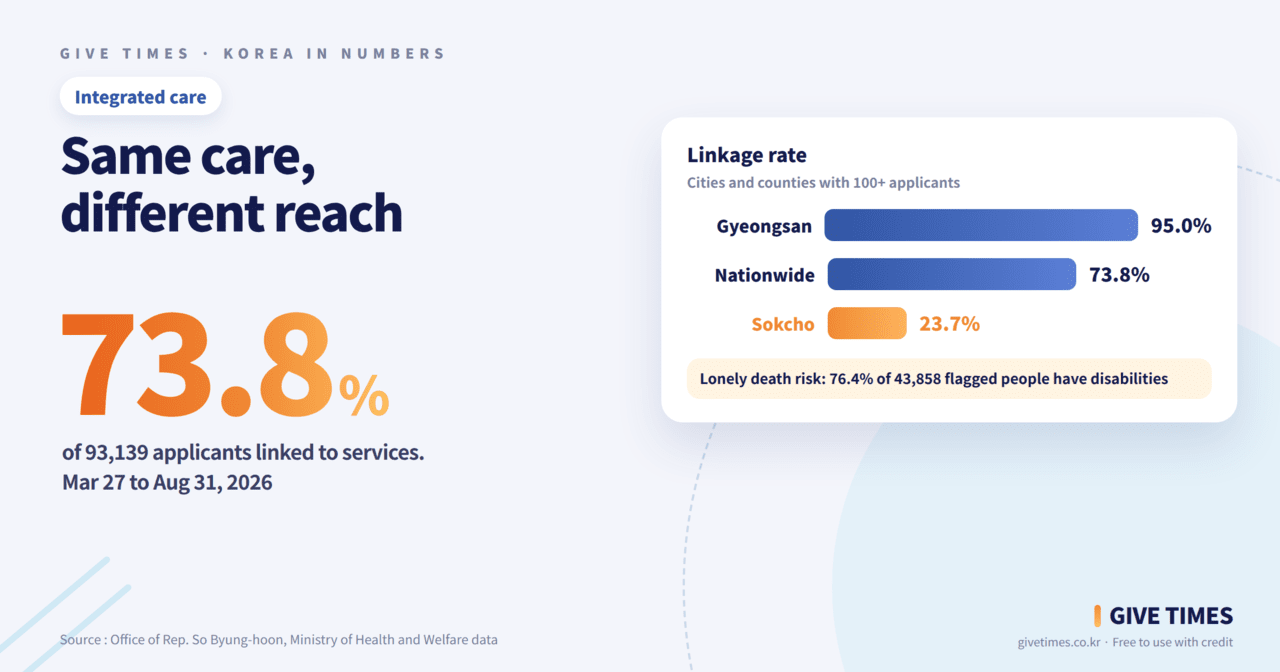
Korea's integrated care program, rolled out nationwide on March 27, received 93,139 applications by the end of August. 73.8% were linked to services, but rates ranged from 95.0% in Gyeongsan to 23.7% in Sokcho
Separately, 76.4% of the 43,858 people flagged as at risk of lonely death were people with disabilities
The program, which connects medical, long-term care and daily support services at home, began nationwide on March 27. So, a member of the National Assembly's Health and Welfare Committee, analyzed processing data from the Ministry of Health and Welfare.
A fourfold gap
Among cities and counties with at least 100 applicants, Gyeongsan linked 666 of 701 applicants (95.0%), while Sokcho linked 49 of 207 (23.7%). By province, Daejeon led at 82.3% and Ulsan trailed at 53.8%. Health Minister Jeong Eun-kyeong told lawmakers on October 7 that about 5,300 dedicated integrated care staff would be in place by the end of the year.
At risk of dying alone
Ministry data obtained by Rep. Seo Mi-hwa show that 33,491 of 43,858 people flagged in the lonely death risk system (76.4%) have disabilities. 71.6% are 65 or older and 69.6% are unemployed.
73.8% · share of 93,139 integrated care applicants linked to services (Mar 27 to Aug 31, 2026)
Office of Rep. So Byung-hoon, integrated care application data from the Ministry of Health and Welfare (as reported by Labor Today and News1, October 5 to 6, 2026)
Office of Rep. Seo Mi-hwa, lonely death risk system data (as reported by Herald Business, September 10, 2026)
Health Kyunghyang, parliamentary audit of the health ministry (October 7, 2026)
Linkage rate = 68,715 ÷ 93,139 = 73.8%
City and county comparisons include only those with at least 100 applicants
People "at risk" are those entered in the system, not deaths
If you find an error, please contact press@givetimes.co.kr.