Korea Found 9.45 Million People in Crisis, but 1.4% Got Emergency Aid
From 2015 to 2025, South Korea's welfare detection system flagged 9,451,321 people in crisis. Only 135,503, or 1.4%, were connected to emergency welfare aid, and 70.5% of those linked to any service went to private services
Blood donors fell from 1,668,424 in 2015 to 1,251,288 in 2025, a drop of 25.0%. Patients' families are now recruiting donors themselves twice as often as last year
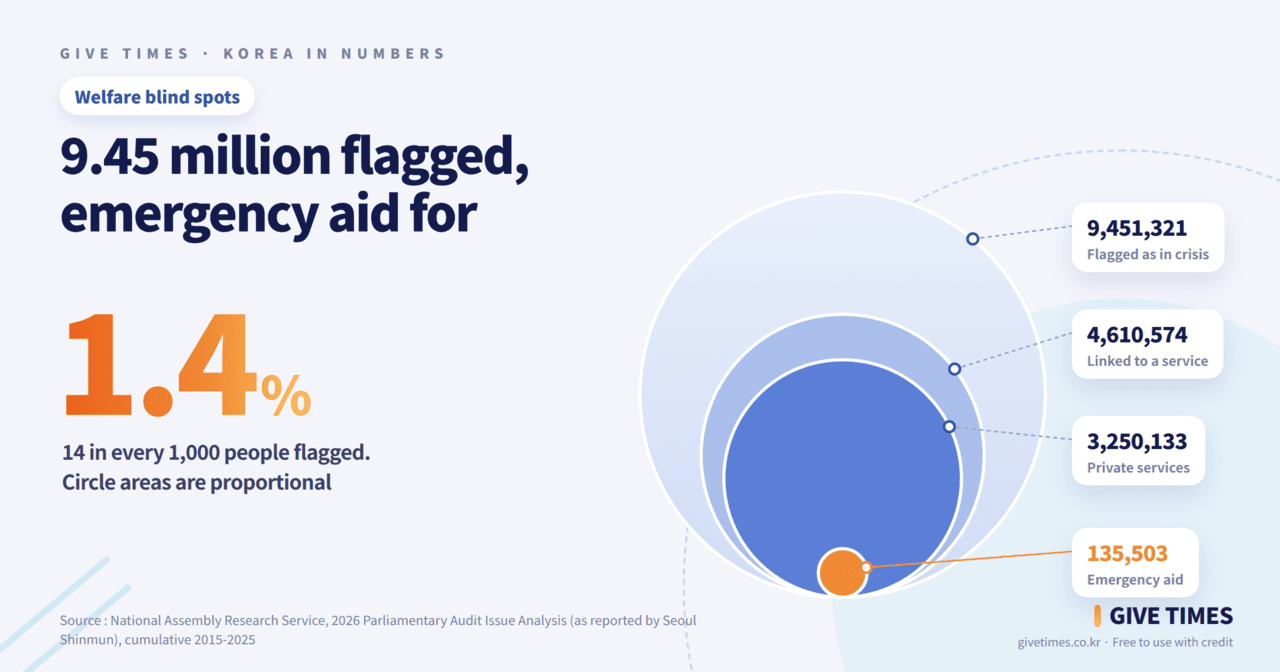
1.4% · share of the 9,451,321 people flagged from 2015 to 2025 who received emergency welfare aid (135,503)
National Assembly Research Service, 2026 Parliamentary Audit Issue Analysis (September 2026, as reported by Seoul Shinmun)
Korea's national statistics agency, blood donor statistics (released October 2, 2026, as reported by Hankyung)
Korean Red Cross Blood Services, 2025 Blood Services Statistical Yearbook
Emergency aid share = 135,503 ÷ 9,451,321 = 1.4%
State funding per emergency aid case, 2014 = 49.9 billion won ÷ 44,344 = about 1.125 million won
State funding per emergency aid case, 2025 = 373 billion won ÷ 410,375 = about 909,000 won (down 19.2%)
Blood donors decline = 1,668,424 - 1,251,288 = 417,136 (25.0%)
The 9.45 million is a cumulative count over 11 years and may include people flagged more than once
Funding per case covers central government funds only
The original agency behind the designated donation figures · not named in the reports
South Korea's parliamentary audit season opens on October 6. Ahead of it, the National Assembly Research Service reported that the country's welfare blind spot detection system, which combines 47 types of crisis signals such as utility cutoffs and unpaid health insurance premiums, flagged 9,451,321 people from 2015 to 2025.
A safety net that leans on charity
Of those flagged, 4,610,574, or 48.8%, were connected to a public or private service. The remaining 4,840,747 were not connected to any service, Give Times calculated. Only 135,503 people, 1.4% of the total, received emergency welfare aid.
Among those who were connected, 70.5% went to private services, such as those run by welfare centers, food banks and charities. The report does not say which organizations provided them. Basic livelihood security accounted for 5.6% and near-poverty support for 1.8%.
Central government funding for emergency aid rose 7.5 times, from 49.9 billion won in 2014 to 373 billion won in 2025, while the number of cases rose 9.3 times. By Give Times' calculation, funding per case fell 19.2%, from about 1.125 million won to about 909,000 won.
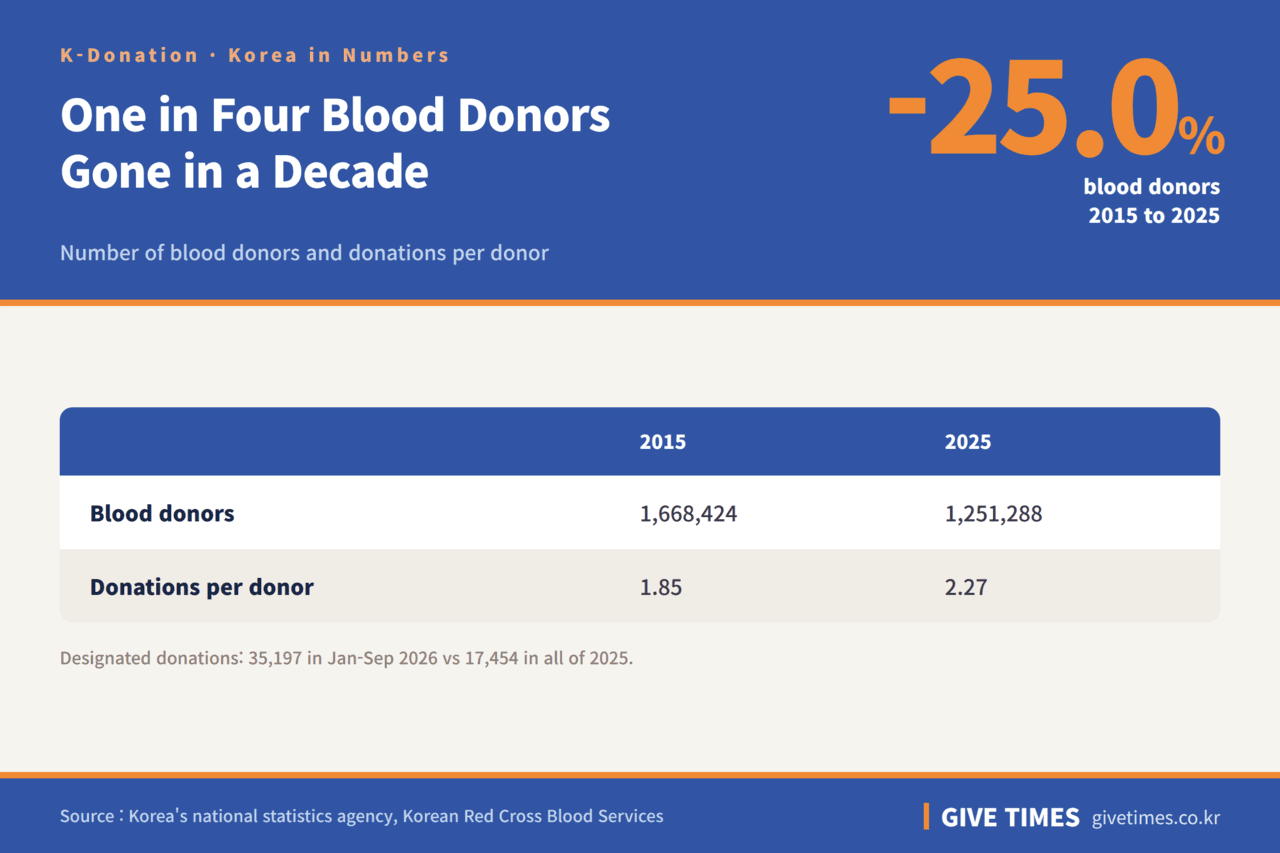
Fewer donors, giving more often
The number of people who donated blood fell to 1,251,288 in 2025, the lowest since records began in 2005 and 25.0% below 2015. Donations themselves fell only 7.9%, because remaining donors give more often: 2.27 times a year on average, up from 1.85.
Designated donations, in which a patient's family finds donors for a specific patient, reached 35,197 from January to September this year, more than double the 17,454 recorded in all of last year, according to Hankyung. Health authorities are reportedly considering raising the upper age limit for blood donation from 69 to 74.
Sources
National Assembly Research Service, 2026 Parliamentary Audit Issue Analysis (September 2026)
Seoul Shinmun, September 2026
Korea's national statistics agency, October 2, 2026
Korean Red Cross Blood Services, 2025 Blood Services Statistical Yearbook
Hankyung, October 2, 2026
If you find an error, please contact press@givetimes.co.kr.