Korea's Hometown Donations More Than Doubled in Two Years, but the Average Gift Fell 12%
Korea's hometown love donation raised 151.53 billion won in 2025, 2.3 times the 2023 total
Yet the average gift per donation fell from about 123,700 won to about 108,900 won, as nearly all gifts clustered at or below the 100,000-won full-credit line
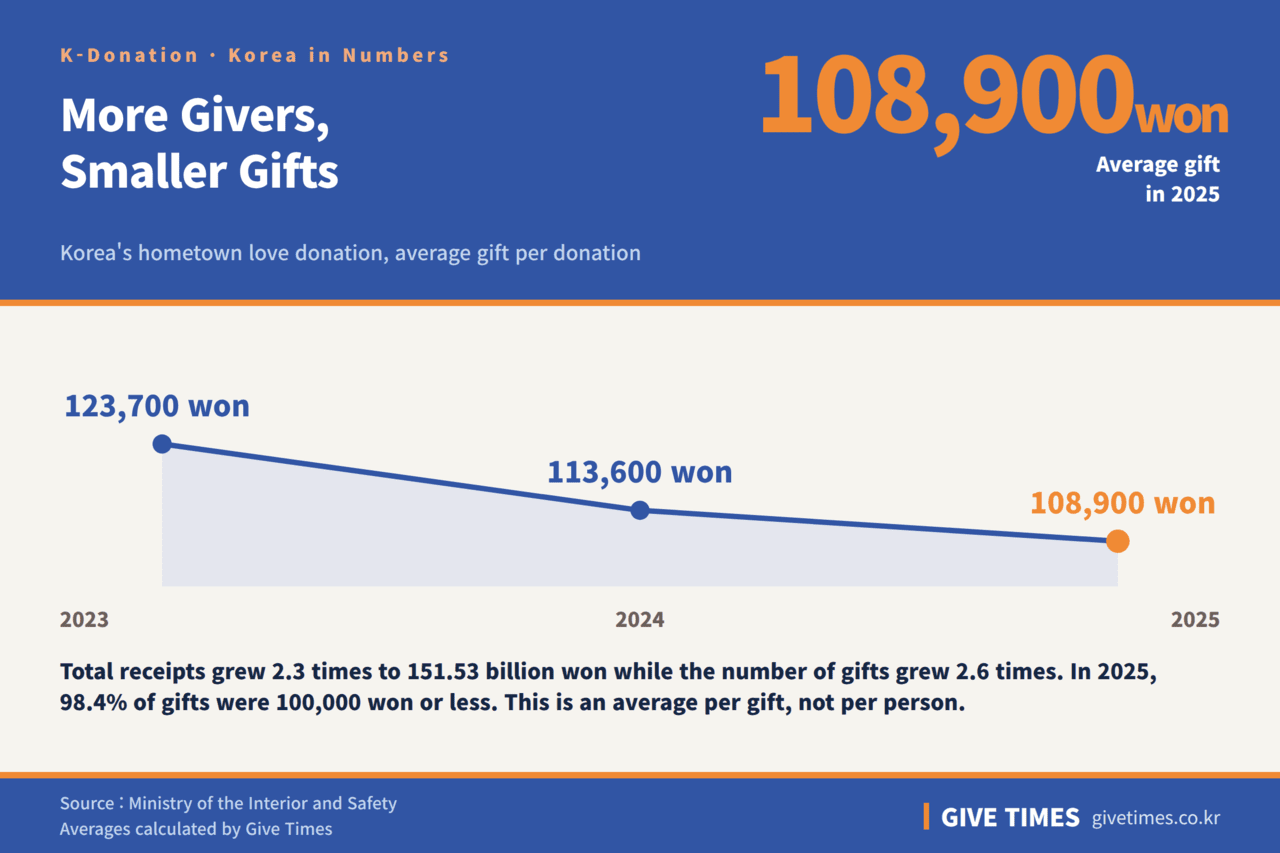
About 108,900 won · average hometown love donation per gift in 2025 (Give Times calculation)
Ministry of the Interior and Safety, 2025 hometown love donation results (January 29, 2026)
Ministry of the Interior and Safety, 2024 hometown love donation results (January 22, 2025)
2025 average about 108,900 won = 151.53 billion won ÷ 1,392,000 gifts
2023 average about 123,700 won = 65.06 billion won ÷ 526,000 gifts
Non-capital share of 10,000 won = 9,220 won (92.2%)
The ministry does not publish an average gift. Give Times divided total receipts by the number of gifts and rounded to the nearest 100 won
A "gift" is a single donation. One person giving to several localities counts several times, so this is not a per-person average
The number of unique donors · not found in the release
Korea's hometown love donation, which lets people give to a local government other than the one they live in, raised 151.53 billion won in 2025, according to the Ministry of the Interior and Safety.
That is 2.3 times the 65.06 billion won raised in 2023, the program's first year. The number of gifts grew faster, from 526,000 to 1.392 million.
Because the number of gifts outpaced the money, the average gift shrank. Give Times calculates it at about 123,700 won in 2023, about 113,600 won in 2024 and about 108,900 won in 2025, a drop of roughly 12% over three years.
The 100,000-won line
Almost every gift sits at or below 100,000 won. The ministry puts that share at 98.4% in 2025, up from 98.1% in 2024.
That line matches the structure of the tax credit. Donations up to 100,000 won are fully credited against income tax, and donors can receive local gifts worth up to 30% of the amount. Above 100,000 won the credit rate drops to 44%.
The ministry did not survey donors on why they chose their amounts, so the link between the credit structure and the clustering is Give Times' reading of the figures, not a finding.
Chuseok promotions follow the same line. Local governments including Pohang, Namyangju and Buan are running holiday events this week, and each one sets its threshold at 100,000 won, according to a Seoul Shinmun report on September 21.
A proposed change
The government's 2026 tax reform proposal would raise the credit rate for the 100,000 to 200,000-won band from 44% to 55% for donations to non-capital areas outside metropolitan cities. That change, if passed by the National Assembly, would apply to gifts made from January 1 next year.
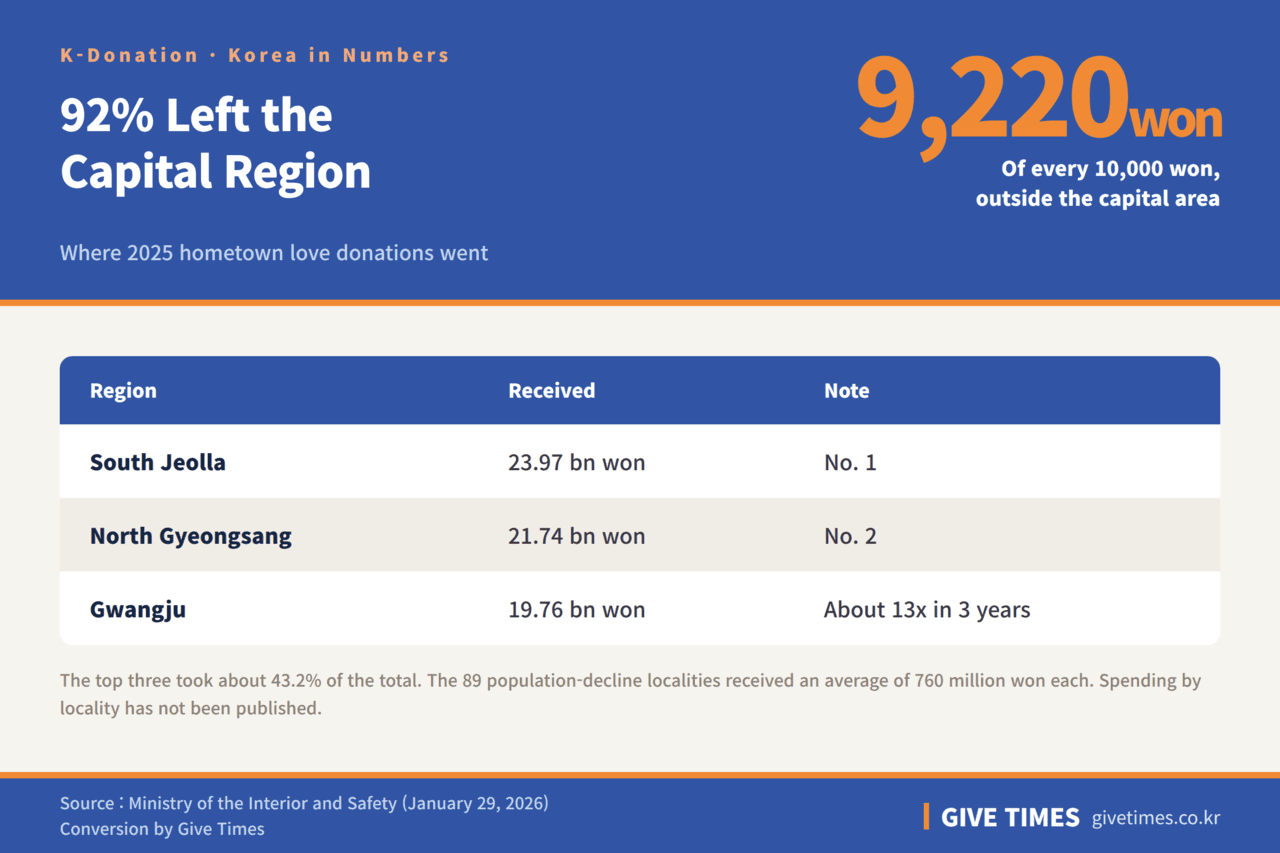
Where the money went
Of the 151.53 billion won, 92.2%, or 139.71 billion won, went to local governments outside the Seoul capital region. Put in terms of 10,000 won, 9,220 won left the capital area.
South Jeolla Province received the most at 23.97 billion won, followed by North Gyeongsang Province at 21.74 billion won and Gwangju at 19.76 billion won. Together the three took about 43.2% of the total.
The 89 localities designated as population-decline areas received an average of 760 million won each.
The ministry has not yet published how each locality spent its fund.
Sources
Ministry of the Interior and Safety, 2025 hometown love donation results, January 29, 2026
Ministry of the Interior and Safety, 2024 hometown love donation results, January 22, 2025
Seoul Shinmun, Chuseok hometown donation events, September 21, 2026
Government of Korea, 2026 tax reform proposal, August 3, 2026
Give Times calculations
Average gift per year = total receipts ÷ number of gifts, rounded to the nearest 100 won.
Three-year decline about 12.0% = (123,688 − 108,858) ÷ 123,688.
Top three share about 43.2% = (23.97 + 21.74 + 19.76) ÷ 151.53 billion won.
If you find an error, please contact press@givetimes.co.kr.