Policy & Law: Five Checks Before You Donate in Korea, and Where the Law Already Makes the Answers Public
Much of what a donor needs to judge a Korean fundraiser is already public, because the law requires it
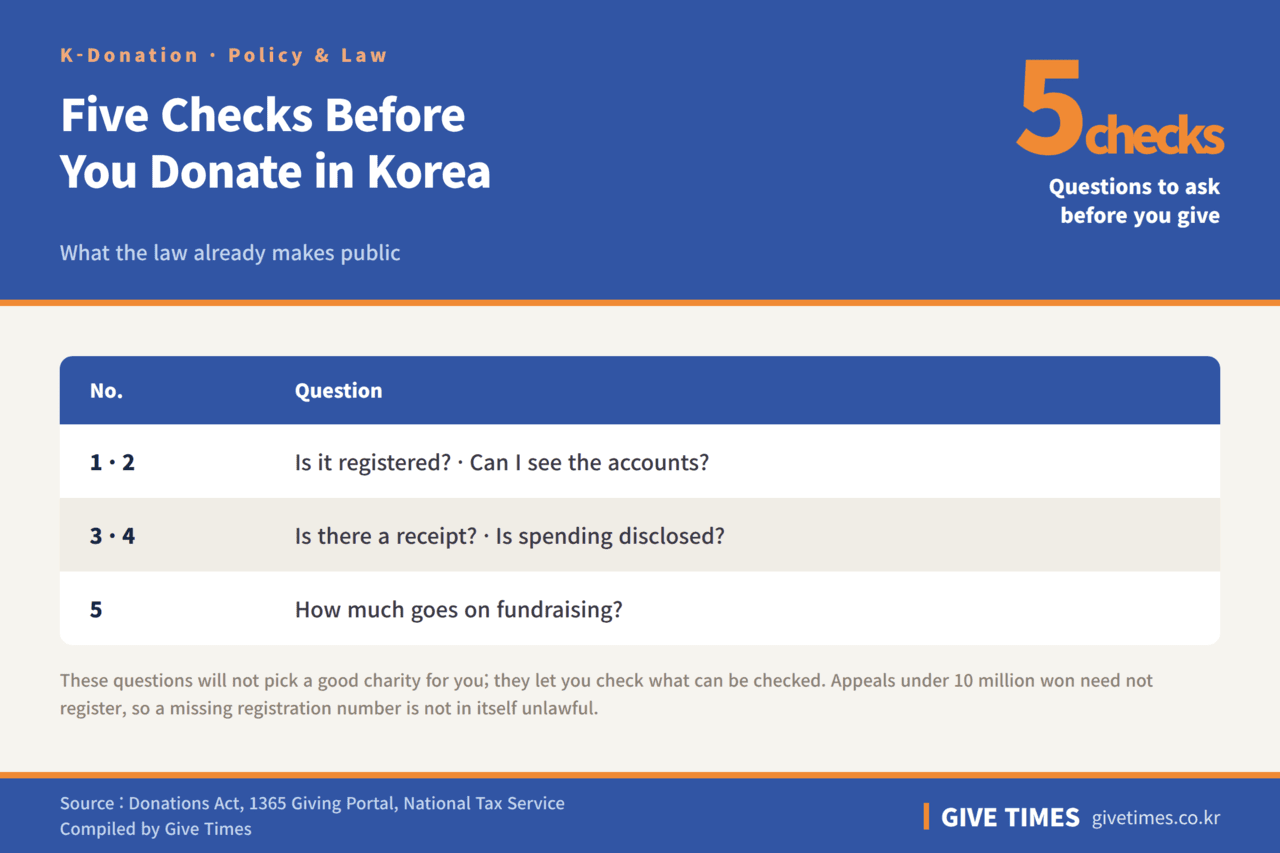
Here are five questions to ask and where to find each answer yourself
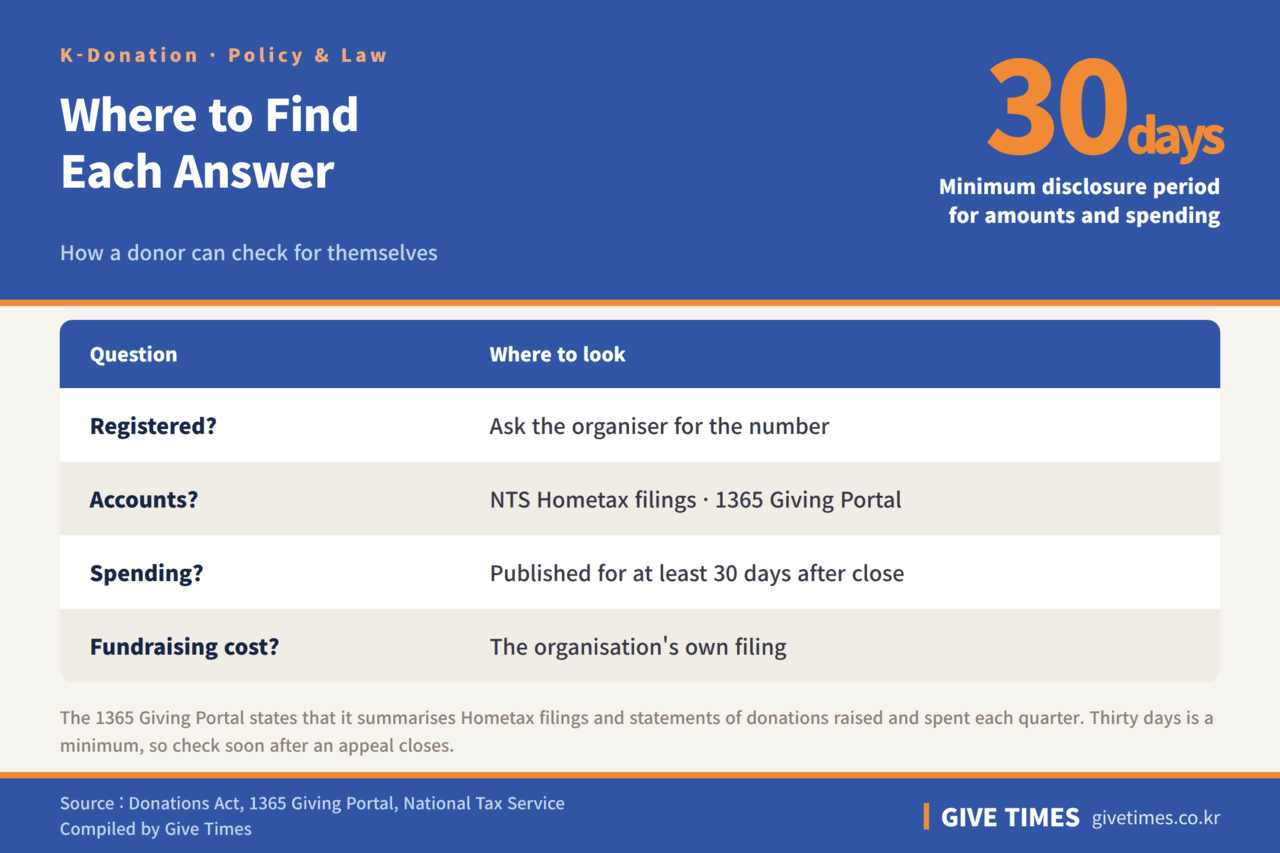
30 days · minimum period a registered fundraiser must publish amounts raised and how they were spent
Act on the Collection and Use of Donations (기부금품의 모집·사용 및 기부문화 활성화에 관한 법률) and its Enforcement Decree
1365 Giving Portal (nanumkorea.go.kr), public-interest corporation lookup service
National Tax Service of Korea, Public-Interest Corporation Annual Report, published 21 May 2026
Legal thresholds are transcribed from the statute
Aggregate fundraising cost approx. 364 won per 10,000 won = 400bn ÷ 11tn × 10,000 (from Give Times article 161)
This article describes the structure of the law. It is not legal advice on any individual case
Appeals under 10 million won are not required to register. A missing registration number is not in itself unlawful
The 364 won figure is an aggregate across all filing corporations, not a benchmark for any single organisation
Differences in tax credit by donee category (statutory, designated, other) · not confirmed in current law
The fundraising-cost ceiling in Annex 1 of the Enforcement Decree · original text not confirmed
Whether 1365 Giving Portal data can be downloaded in bulk · not confirmed
The most common reason people in Korea give for not donating is that they do not know whom to trust.
Much of what is needed to make that judgement is already public, because the law requires it. It is simply scattered, and few donors know where to look. Here are five questions, each with the place to find the answer.
1. Is the appeal registered?
Korea's donations act requires anyone seeking to raise 10 million won or more to register. Appeals above 1 billion won register with the Minister of the Interior and Safety; smaller ones register with the provincial governor where the organiser is based.
So the first question is simply: what is the registration number?
A registered appeal must publish the organiser's name, the registration number, the amount raised and how it was spent. An organiser who cannot answer the question promptly has told you something.
Appeals under 10 million won are not required to register, so a missing number is not in itself unlawful. For small appeals, move on to the other questions.
2. Can I see the organisation's accounts?
Public-interest corporations file settlement statements with the National Tax Service every year, including how much they received in donations and how they spent it.
There are two places to look: the public-interest corporation disclosure system on the NTS Hometax site, and the government's 1365 Giving Portal (nanumkorea.go.kr). The portal states that it summarises, on a quarterly basis, the settlement filings published on Hometax together with statements of donations raised and spent. It can be searched by type of public-interest activity and by donee category (statutory, designated, other).
3. Will I receive a donation receipt?
The 1365 portal sorts donees into statutory, designated and other categories for a reason: the distinction connects to year-end tax settlement.
Ask the organisation directly whether it issues donation receipts before you give. Give Times has not yet confirmed in current law how the tax credit differs by category and will cover it separately once confirmed.
4. Will it tell me how the money was spent?
Registered appeals carry obligations after they close. The amount raised and the statement of use must be published for at least 30 days, and the organiser must report to the registering authority within 30 days of finishing spending. Appeals above 100 million won must attach an audit report. Using funds for purposes other than those registered is prohibited.
Note that 30 days is a minimum. Taking the disclosure down afterwards is not a breach. If you care about a particular appeal, check soon after it closes.
5. How much goes on fundraising?
Across all public-interest corporations, fundraising cost comes to roughly 3.64% of donation revenue, or about 364 won per 10,000 won. That is an aggregate across 21,318 corporations; individual organisations differ widely, and the figure is useful only as context. The organisation's own filing is where its figure can be found.
A low fundraising ratio is not automatically a sign of a good charity. An organisation that never fundraises has a ratio of zero and no new donors. Look at several years rather than one.
Is five enough?
These questions will not pick a good charity for you. They let you check what can be checked.
That alone changes something. When more donors ask, more organisations answer. The law creates the duty to disclose; donors who ask are what make the disclosures read.
Frequently asked questions
How can I check whether a Korean charity is legitimate?
Ask for the registration number of the appeal, then look up the organisation's settlement filings on the NTS Hometax disclosure system or the 1365 Giving Portal.
Do Korean fundraisers have to disclose how donations are spent?
Registered appeals must publish the amount raised and the statement of use for at least 30 days. Appeals above 100 million won must attach an audit report.
Where can I see a Korean nonprofit's financial statements?
Public-interest corporations file annual settlement statements with the National Tax Service. The 1365 Giving Portal summarises them quarterly.
Is an unregistered appeal illegal?
Not necessarily. Appeals under 10 million won are not required to register.
Open questions
Confirm in current law how tax credits differ by donee category.
Confirm the fundraising-cost ceiling in Annex 1 of the Enforcement Decree.
Confirm whether 1365 portal data can be downloaded in bulk, which would allow organisation-level comparison.
Sources
Act on the Collection and Use of Donations and its Enforcement Decree
1365 Giving Portal (nanumkorea.go.kr), public-interest corporation lookup service description
National Tax Service of Korea, Public-Interest Corporation Annual Report, published 21 May 2026
Give Times calculations
The 364 won figure is 400 billion won divided by 11 trillion won (3.64%) applied to 10,000 won, carried over from Give Times article 161.
Legal thresholds (10 million won, 1 billion won, 30 days, 100 million won) are transcribed from the statute.
How to read these numbers
Give Times attaches this section to every article, because how a number should be read matters as much as the number.
This article does not pick a good charity. It shows how to check what can be checked.
Thirty days is a minimum disclosure period.
The 364 won figure is an aggregate, not a benchmark for any single organisation.
This article describes the structure of the law and is not legal advice.
If anything here is inaccurate, please tell us at https://www.givetimes.co.kr/report and we will check and correct it.