How Korea Gives: Donations Are 11 Trillion Won, or 7% of What Korean Public-Interest Corporations Spend On
Korea's National Tax Service put donation revenue at 21,318 disclosing public-interest corporations at 11 trillion won
Against 156 trillion won of public-purpose revenue, that is 7%. Government grants are 63 trillion won
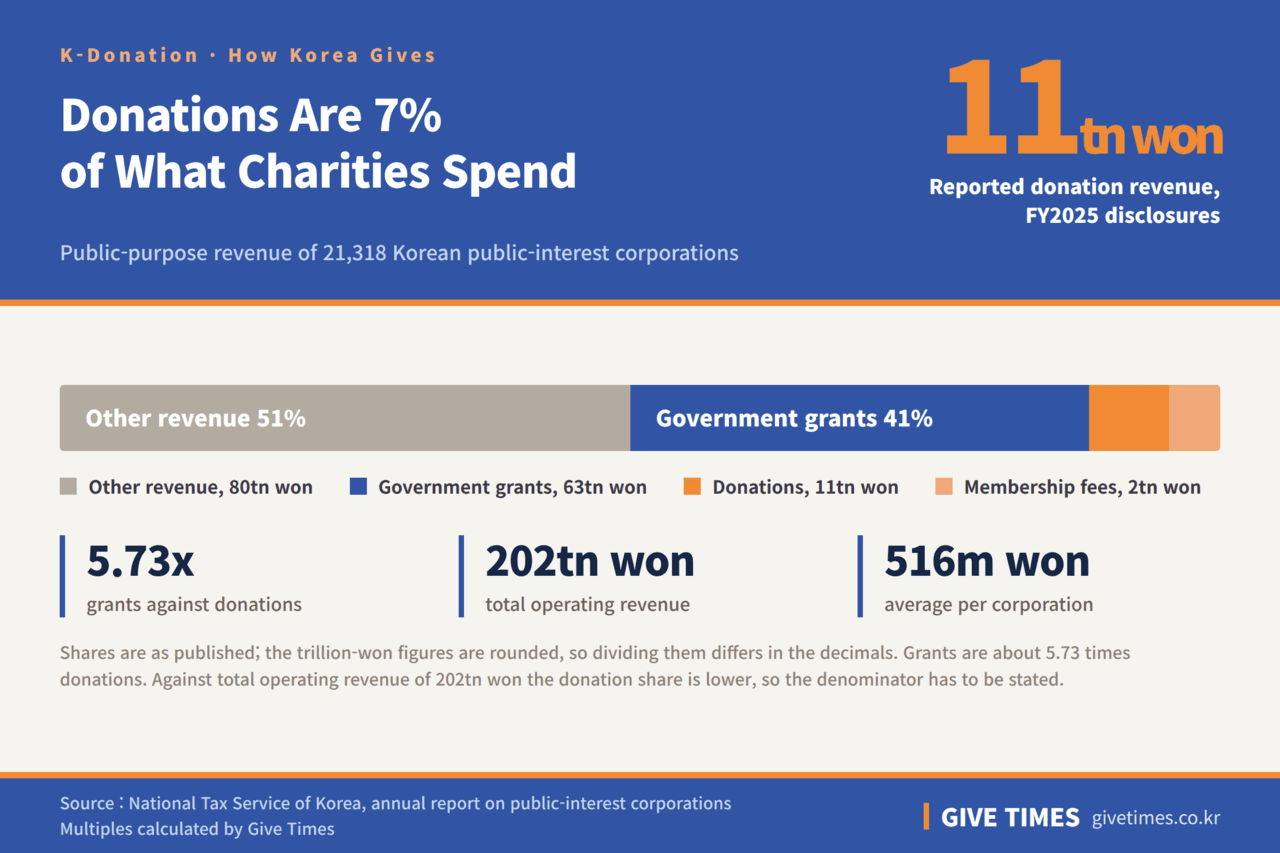
11 trillion won · donation revenue of 21,318 public-interest corporations in Korea (FY2025 disclosures)
National Tax Service of Korea, Public-Interest Corporation Annual Report, published 21 May 2026
Donations as a share of public-purpose revenue approx. 7.05% = 11tn ÷ 156tn
Grants as a multiple of donations approx. 5.73x = 63tn ÷ 11tn
Public-purpose revenue as a share of total operating revenue approx. 77.2% = 156tn ÷ 202tn
Average donation revenue per corporation approx. 516 million won = 11tn ÷ 21,318
Fundraising cost against donation revenue approx. 3.64% = 400bn ÷ 11tn
Programme spending share approx. 90.1% = 145tn ÷ 161tn
Large-asset corporations as a share of all corporations approx. 2.22% = 473 ÷ 21,318
Their share of total assets approx. 78.1% = 317tn ÷ 406tn
Trillion-won figures are rounded in the source report, so dividing them can differ from the published percentages in the decimals
The report gives 41% for grants and 7% for donations; dividing the rounded figures gives 40.38% and 7.05%
The report puts the top 15 recipients at 4 trillion won and 38% of donations; 4tn ÷ 11tn is 36.4%. Give Times uses the published 38%
The 516 million won average is arithmetic. Donations are concentrated, so the median is almost certainly far lower and was not confirmed
Fundraising cost of 400 billion won is reported at 0.3% of public-purpose expenditure. Whether it sits inside programme cost, inside administrative cost, or is counted separately was not confirmed
Median and distribution of donation revenue · not in the report summary
Year-on-year change in the 11 trillion won figure · not confirmed
Split between individual and corporate giving · not confirmed
Composition of the 80 trillion won "other revenue" line · not confirmed
Names of the top 15 recipients beyond one organisation · not confirmed
Eleven trillion won is a large number until you see what it sits next to.
The same report that reports it also reports the comparison.
11 trillion won, in one line
Korea's National Tax Service published its Public-Interest Corporation Annual Report on 21 May 2026, covering 21,318 corporations that filed settlement disclosures for FY2025.
Their combined donation revenue was 11 trillion won. That is roughly 516 million won per corporation on an arithmetic average, a figure Give Times calculated.
The average should be handled carefully. Donations in Korea are concentrated, so most of these corporations receive far less than the average. The median was not published in the summary.
Seven percent, and why that is the wrong headline
Public-purpose revenue across the same corporations was 156 trillion won. It breaks down as government grants 63 trillion won (41%), other revenue 80 trillion won (51%), donations 11 trillion won (7%) and membership fees 2 trillion won (1%). The percentages are as published.
Grants are about 5.73 times donations.
For readers outside Korea, this is the single most useful number in the report. The Korean nonprofit sector is not primarily donation-funded. It is primarily a government-contracted sector, with donations sitting alongside.
But 7% is a misleading headline if it is read as unimportance. Grants arrive with a purpose already set by the state. Membership fees come out of a standing relationship. Donations are the only money that arrives with no obligation attached, which is exactly why the accountability attached to them cannot be the same.
One more caution on the denominator. Total operating revenue was 202 trillion won, of which public-purpose revenue was 156 trillion won, about 77.2%. Calculate the donation share against 202 trillion won instead and it drops below 6%. The denominator has to be stated alongside the percentage.
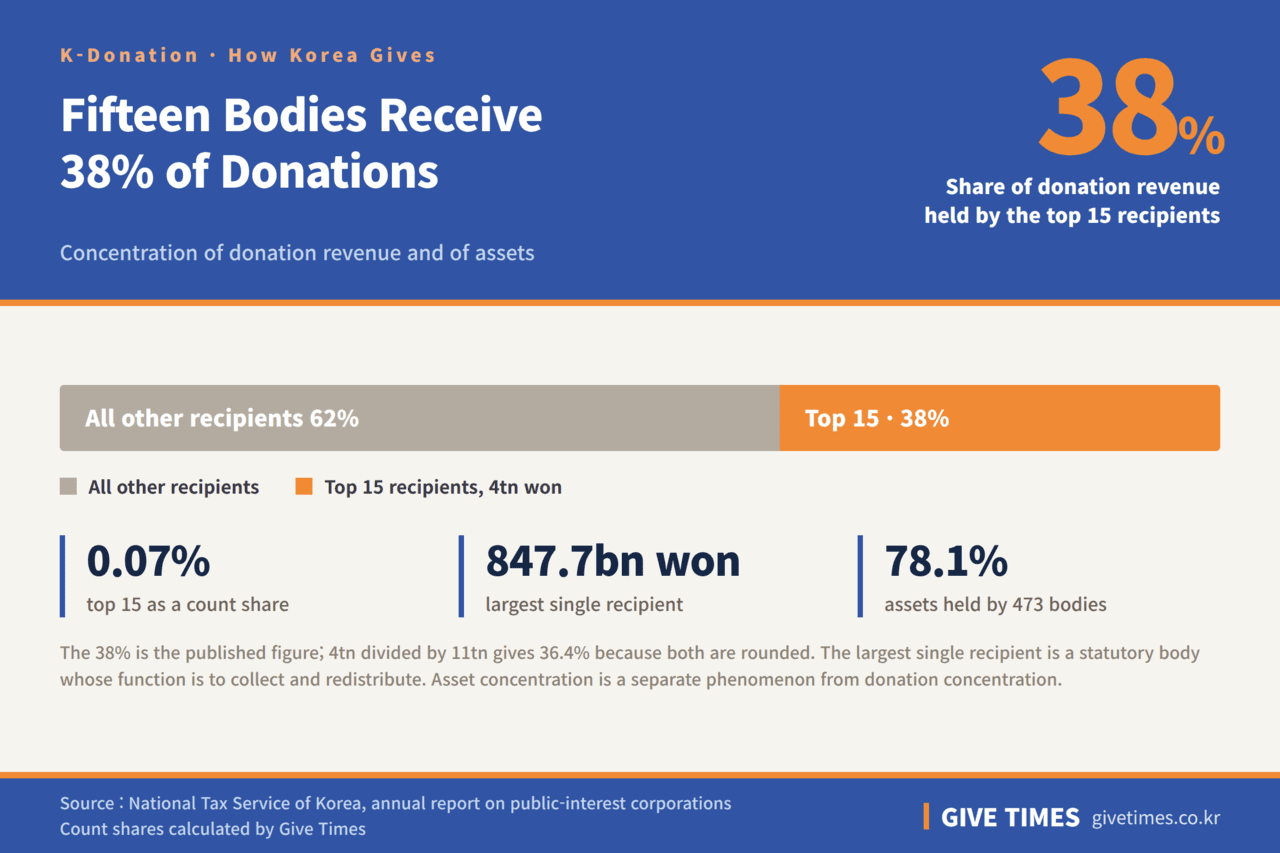
Fifteen organisations take 38%
Donation revenue is not spread evenly.
The top 15 recipients together reported 4 trillion won, which the report puts at 38% of all donation revenue. Fifteen out of 21,318 is about 0.07%, a share Give Times calculated.
A note on that 38%. Dividing 4 trillion by 11 trillion gives 36.4%, because both are rounded to the nearest trillion. Give Times uses the published 38% rather than the divided figure.
The single organisation identified in the report summary is the Community Chest of Korea, with 847.7 billion won, or 8% of all donation revenue. It is a statutory body whose function is to collect and redistribute, so concentration there is a description of its role rather than a finding about it.
Concentration is sharper in assets. Corporations holding 1 trillion won or more in total assets number 473, about 2.22% of the total, and they hold 317 trillion won, about 78.1% of the sector's 406 trillion won. Of those 473, some 202 are in education and 113 employ more than a thousand people. Large university foundations and hospitals account for much of it, and those assets are often long-standing endowments rather than recent giving. Asset concentration and donation concentration should not be read as the same phenomenon.
What it costs to raise the money
Public-purpose expenditure was 161 trillion won: programme spending 145 trillion won (90%), administrative cost 16 trillion won (10%), and fundraising cost 400 billion won (0.3%).
Measured against donation revenue rather than total expenditure, fundraising cost is about 3.64%, which works out to roughly 364 won on a 10,000 won gift. Both figures are Give Times calculations, and both need the same caution: they are aggregates, not the ratio at any particular organisation.
Two things were not confirmed. Whether the 400 billion won sits inside the programme or administrative lines or is counted separately. And whether it covers the cost of raising donations alone or of raising all revenue, which decides whether the numerator and denominator actually correspond.
The 90% programme share also carries a denominator caveat. Its base is total public-purpose expenditure, most of which is grant-funded. It is not the share of donated money that reaches programmes.
What this report does not say
It does not say whether donations are rising or falling. The year-on-year change was not confirmed.
It does not separate individual from corporate giving, so a fall in household giving offset by corporate giving would be invisible here.
It does not explain the 80 trillion won "other revenue" line, which is more than half of public-purpose revenue.
And it covers only corporations that filed settlement disclosures. Anything outside that filing population is not in these totals.
Frequently asked questions
How much money do Korean charities receive in donations?
Eleven trillion won across 21,318 public-interest corporations that filed FY2025 settlement disclosures, per the National Tax Service annual report.
What share of Korean nonprofit revenue comes from donations?
Seven percent of public-purpose revenue of 156 trillion won. Against total operating revenue of 202 trillion won the share is lower. The denominator must be stated.
Are Korean charities funded mainly by donations?
No. Government grants were 63 trillion won, about 5.73 times donation revenue.
How concentrated is charitable giving in Korea?
The top 15 recipients account for 38% of donation revenue. One organisation, the Community Chest of Korea, accounts for 8%.
How much does it cost Korean charities to raise donations?
Reported fundraising cost was 400 billion won, 0.3% of public-purpose expenditure and about 3.64% of donation revenue. This is an aggregate, not an organisation-level ratio, and the accounting treatment was not confirmed.
Does 90% of donated money reach programmes?
That is not what the figure says. Programme spending is 90% of total public-purpose expenditure, most of which is grant-funded.
Open questions
Confirm the median and distribution of donation revenue. The arithmetic average is unlikely to be representative.
Confirm the year-on-year change in donation revenue. A total says nothing about direction.
Confirm the split between individual and corporate giving.
Confirm the composition of the 80 trillion won "other revenue" line.
Confirm the accounting treatment of fundraising cost and whether it corresponds to donation revenue.
Sources
National Tax Service of Korea, Public-Interest Corporation Annual Report, published 21 May 2026, based on FY2025 settlement disclosures
Give Times calculations
Donations as a share of public-purpose revenue approx. 7.05% is 11tn divided by 156tn. The report publishes 7%.
Grants as a multiple of donations approx. 5.73x is 63tn divided by 11tn.
Public-purpose revenue as a share of total operating revenue approx. 77.2% is 156tn divided by 202tn.
Average donation revenue per corporation approx. 516 million won is 11tn divided by 21,318.
Fundraising cost against donation revenue approx. 3.64% is 400bn divided by 11tn; 364 won is that rate applied to 10,000 won.
Programme spending share approx. 90.1% is 145tn divided by 161tn. The report publishes 90%.
Large-asset corporations approx. 2.22% of the total is 473 divided by 21,318; their asset share approx. 78.1% is 317tn divided by 406tn.
The 38% top-15 share is the published figure and not a Give Times calculation.
How to read these numbers
Give Times attaches this section to every article, because how a number should be read matters as much as the number.
Rounded trillion-won figures divide imperfectly. Published percentages are preferred over divided ones here.
Seven percent is against public-purpose revenue of 156 trillion won, not against total operating revenue of 202 trillion won.
A low share is not the same as low importance. Donations are the only revenue that arrives without an obligation attached.
The 516 million won average is arithmetic and almost certainly not representative.
Asset concentration and donation concentration are different phenomena and should not be merged.
The 364 won figure is an aggregate ratio. It is not what any given 10,000 won gift is charged.
Ninety percent programme spending is measured against all public-purpose expenditure, most of it grant-funded.
If anything here is inaccurate, please tell us at https://www.givetimes.co.kr/report and we will check and correct it.