How Korea Gives: 21,318 Public Interest Corporations, and Where Only 5% of the Money Is Donated
Korea's National Tax Service published its first annual report on public interest corporations on 21 May 2026
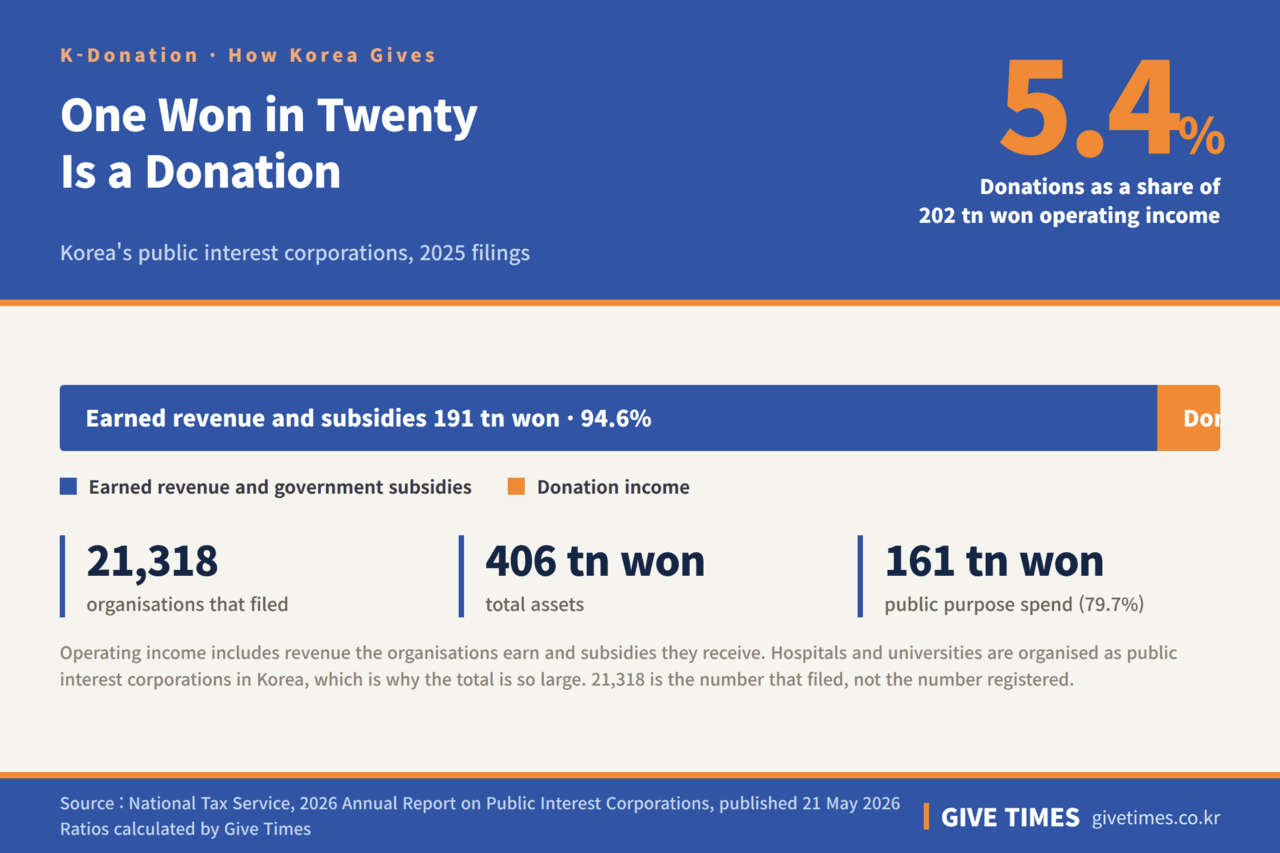
21,318 organisations filed 2025 accounts. They hold 406 trillion won in assets, but donations are only 5.4% of what comes in
21,318 · public interest corporations that filed 2025 settlement documents in Korea
Donation share of income 5.4% = 11 tn won ÷ 202 tn won
Public purpose expenditure share 79.7% = 161 tn won ÷ 202 tn won
Average assets per organisation approx. 19.05 bn won = 406 tn won ÷ 21,318
Average donation income per organisation approx. 516 mn won = 11 tn won ÷ 21,318
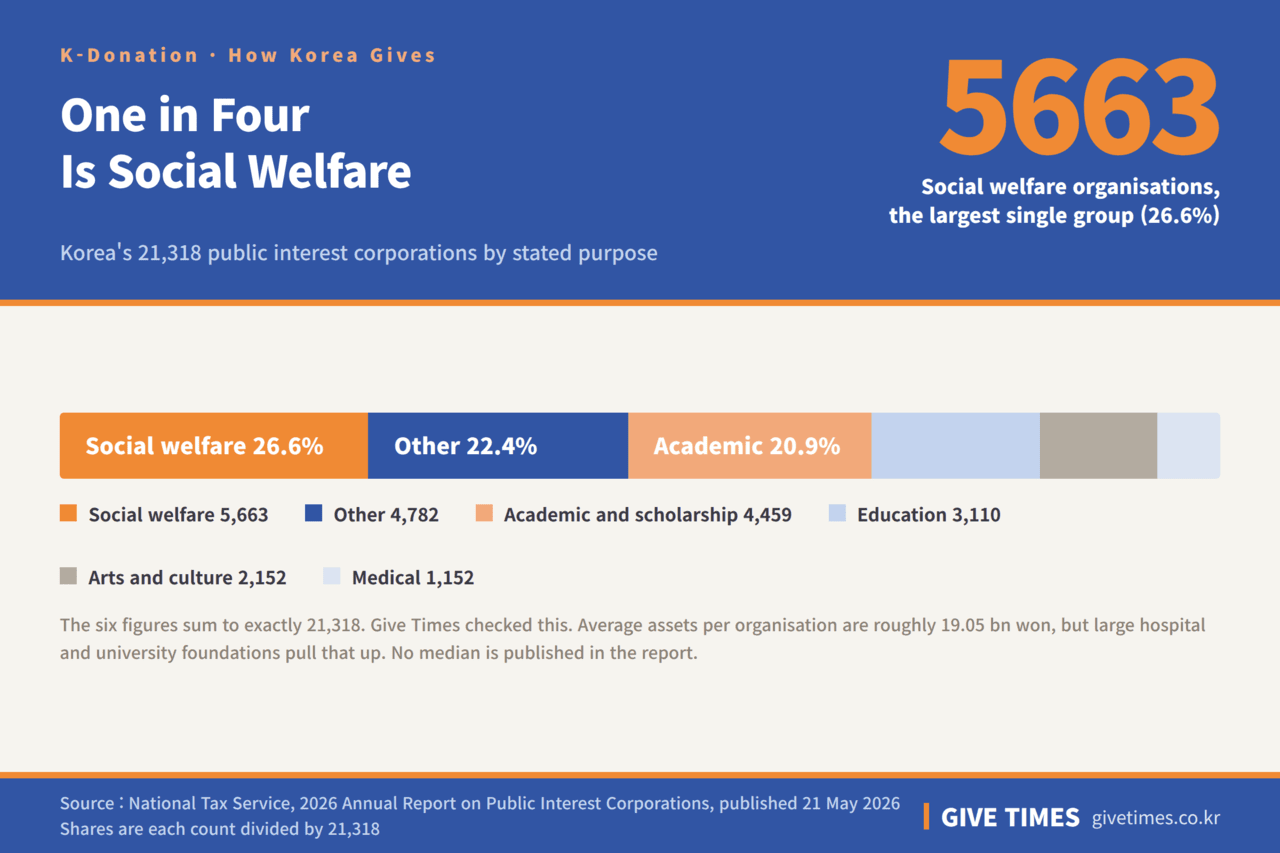
Type totals check 21,318 = 5,663 + 4,782 + 4,459 + 3,110 + 2,152 + 1,152
Social welfare share 26.6% = 5,663 ÷ 21,318
21,318 is the number that filed. It is not necessarily the number registered
Averages here are Give Times divisions. Large hospital and university foundations sit in the same pool, so the median is likely far lower
202 trillion won in operating income includes earned revenue and government subsidies, not only donations
The gap between registered and filing organisations · Give Times could not obtain it
Median assets and median donation income · not found in the report
The number of organisations that failed to file · not confirmed
If you want to know where charitable money in Korea actually goes, you have to look at public interest corporations.
Until this year those figures existed only one organisation at a time. Korea's National Tax Service has now put them in one place, and the first thing the aggregate shows is that donations are a small slice of the sector's money.
21,318 organisations filed
The National Tax Service published the 2026 Annual Report on Public Interest Corporations on 21 May 2026. It is the first edition.
21,318 organisations filed settlement documents for the 2025 business year.
By type, social welfare is the largest group at 5,663 organisations, 27% of the total. Other purposes account for 4,782 (22%), academic and scholarship for 4,459 (21%), education for 3,110 (15%), arts and culture for 2,152 (10%), and medical for 1,152 (5%).
The six type figures sum to exactly 21,318. Give Times checked this.
One qualification belongs at the front. 21,318 is the number of organisations that filed. Whether it matches the number registered is not stated in the report, and Give Times could not confirm it independently.
Donations are 5% of the income
The sector holds 406 trillion won in total assets and reports 202 trillion won in operating income.
Donation income inside that is 11 trillion won. Divided by 202 trillion won, that is 5.4%.
About one won in twenty entering Korea's public interest corporations is a donation.
Where does the rest come from? Operating income includes revenue the organisations earn themselves and subsidies they receive from government. Medical foundations that run hospitals and education foundations that run universities are counted in this pool, which is why the total is so large.
On the spending side, public purpose expenditure is 161 trillion won, or 79.7% of operating income.
That 79.7% figure deserves the same care as the 5.4%. It is a sector aggregate. It says nothing about any individual organisation, and a reader deciding where to give cannot use it as a screen.
What the averages do and do not show
Dividing by 21,318 gives an average organisation: roughly 19.05 billion won in assets and roughly 516 million won in annual donation income. Both are Give Times calculations.
These averages should be read with caution. The 406 trillion won in assets includes foundations that own large hospitals and universities. A handful of those pull the average a long way up.
The median is the figure that would show what a typical organisation looks like, and Give Times did not find it in the report. Until it is published, the average is a description of the sector's total divided by its headcount, not a description of any organisation in it.
Four months, and a public search box
Korean public interest corporations must publish their financial statements and related settlement documents on Hometax, the National Tax Service's online system, within four months of the end of their business year.
Anyone can read them. If you are considering a donation to a particular organisation, you can search it by name.
The tax service gave a specific reason for compiling the report: until now the public could only see one organisation's documents at a time. Without an aggregate, a donor has no way to judge the size of the field their money enters.
Disclosure and readership are not the same thing. The documents have been public for years. What did not exist was a way to read them together. This report is a first attempt at that, and its usefulness will be measured by whether the second edition adds medians, filing compliance rates, and a year-on-year series.
How Korea's structure compares
For readers outside Korea, the term needs unpacking. A "public interest corporation" in Korean tax law is an entity that receives tax benefits in exchange for pursuing a stated public purpose, and it is the category that issues donation receipts for tax deduction. It is closer in function to a registered charity or a 501(c)(3) organisation than to an informal nonprofit association.
Two structural features are worth noting for comparison. First, oversight sits with the tax authority rather than a dedicated charity regulator, which is a different arrangement from England and Wales, where the Charity Commission holds the register. Second, because hospitals and universities are organised as public interest corporations in Korea, sector totals include service revenue at a scale that a donation-focused reading will misinterpret.
Give Times is not making a comparative claim about which structure performs better. The point is narrower: cross-country charity totals are not directly comparable unless the category definitions are matched first, and in Korea's case the category is unusually broad.
Frequently asked questions
How many charitable organisations are there in Korea?
21,318 public interest corporations filed 2025 settlement documents, according to the National Tax Service's first annual report, published 21 May 2026. Whether this equals the number registered is not stated in the report.
How much of Korean nonprofit income comes from donations?
11 trillion won out of 202 trillion won in operating income, or 5.4%. The rest is earned revenue and government subsidies.
What is the largest type of public interest corporation in Korea?
Social welfare, with 5,663 organisations, 27% of the total.
How much does an average Korean public interest corporation hold?
Roughly 19.05 billion won in assets and roughly 516 million won in annual donation income, by Give Times calculation. These averages are distorted upward by large hospital and university foundations, and the median is not published.
How can I check a Korean charity's financial statements?
They must be filed on Hometax, the National Tax Service's online system, within four months of the end of the business year, and they are open to public search by organisation name.
What share of the money goes to public purposes?
161 trillion won of 202 trillion won, or 79.7%, at sector level. This is an aggregate and cannot be applied to any individual organisation.
Open questions
The gap between registered and filing organisations. Without it, the compliance rate cannot be stated.
Median assets and median donation income. The averages alone cannot describe a typical organisation.
The number of organisations that failed to file, and what follows when they do not.
A year-on-year series. A single year cannot show whether the donation share is rising or falling.
Whether the 79.7% public purpose expenditure ratio varies by type. Sector aggregates hide the distribution.
Sources
nts0521 · National Tax Service, "2026 Annual Report on Public Interest Corporations," first edition, published 21 May 2026
nts_hometax · National Tax Service, Hometax public interest corporation disclosure system, settlement document search
Give Times calculations
The 5.4% donation share is 11 trillion won divided by 202 trillion won (5.45%).
The 79.7% public purpose expenditure share is 161 trillion won divided by 202 trillion won (79.70%).
Average assets of approximately 19.05 billion won is 406 trillion won divided by 21,318 (19.045 bn).
Average donation income of approximately 516 million won is 11 trillion won divided by 21,318 (515.9 mn).
The 26.6% social welfare share is 5,663 divided by 21,318 (26.56%). The report's own rounding shows 27%.
The type total check: 5,663 + 4,782 + 4,459 + 3,110 + 2,152 + 1,152 = 21,318, an exact match.
How to read these numbers
Give Times attaches this section to every article. How a number should be read matters as much as the number itself.
21,318 counts organisations that filed, not organisations that exist.
406 trillion won in assets is not charitable money available to spend. Much of it is hospital and campus infrastructure.
202 trillion won is operating income, not donations. Reporting it as the size of Korean giving would be wrong by a factor of about eighteen.
5.4% is a sector ratio. Individual organisations vary enormously, and some are funded almost entirely by donations.
The per-organisation averages are total divided by headcount. Without a median they should not be used to picture a typical organisation.
79.7% is an aggregate spending ratio and is not a quality score for any single organisation.
If anything here is inaccurate, please tell us at https://www.givetimes.co.kr/report and we will check it and correct it.