26.1% of South Koreans Gave Last Year, and 54.6% of Cash Givers Went Through a Fundraising Body
Cash givers donated 9.8 times a year on average, roughly once every 37 days
Another 39.6% say they intend to give, a gap of 13.5 percentage points over those who actually did
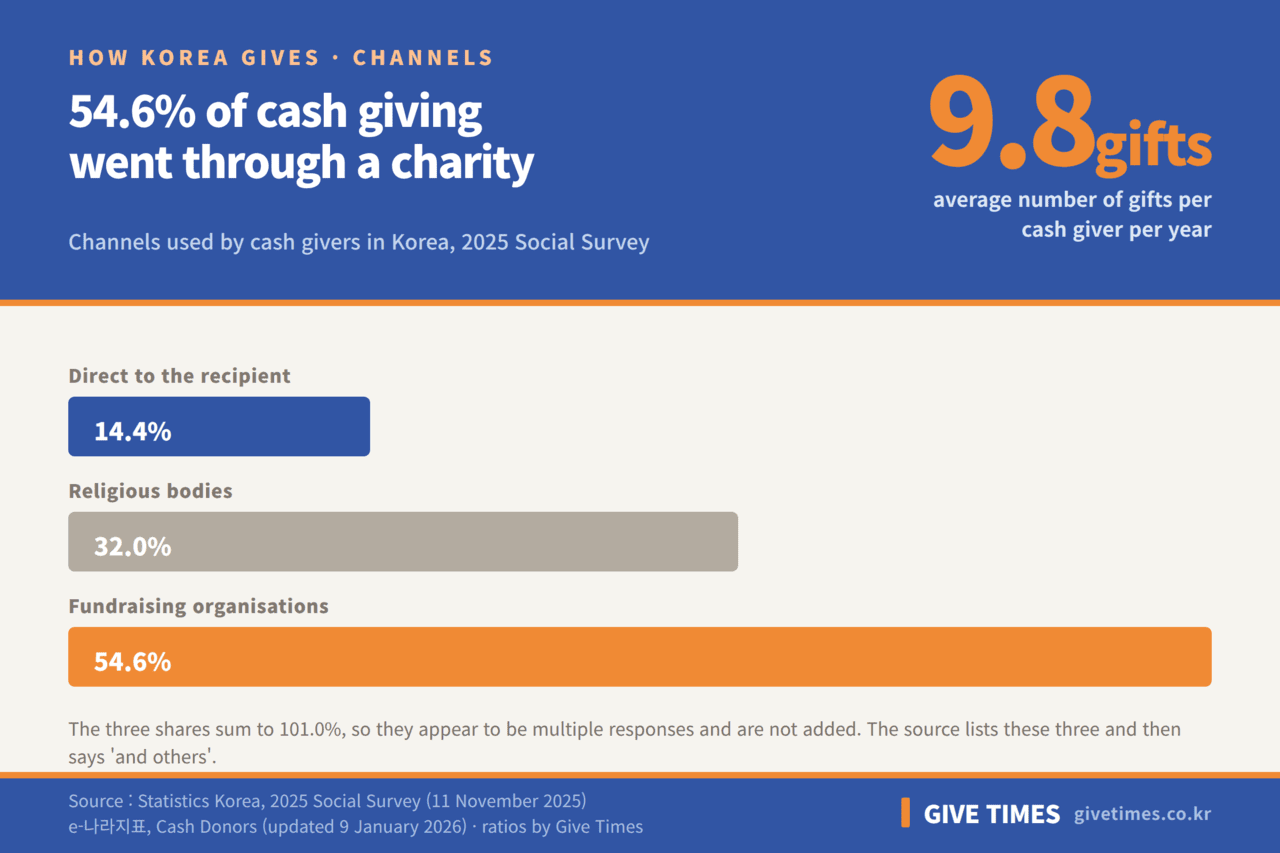
54.6% · share of cash givers in Korea who gave through a fundraising organisation
Statistics Korea (National Data Office), 2025 Social Survey (announced 11 November 2025)
Fieldwork 14 to 29 May 2025; about 19,000 sample households, some 34,000 members aged 13 and over
e-나라지표 national indicator, Cash Donors (updated 9 January 2026, drawn from the Social Survey)
Gap between intention and behaviour 13.5 points = 39.6% − 26.1%
Rebound from the 2021 low 4.5 points = 26.1% − 21.6%
Decline from 2015 3.8 points = 29.9% − 26.1%
Cash giving in 2023 22.6% = 24.9% − 2.3 points
Average interval about 37 days = 365 ÷ 9.8
The 9.8 figure is the average among cash givers, not among the whole population
The three channel shares (54.6%, 32.0%, 14.4%) sum to 101.0%, so they appear to be multiple responses and are not added
26.1% is above the 2021 low but 0.6 points below the 26.7% recorded in 2017
Whether online platforms appear as a separate channel category · amounts given by channel
Official confirmation that channel responses are multiple choice · differences by age group
Split between recurring and one-off giving
In South Korea, 26.1 percent of people gave to charity in the year to May 2025. Among those who gave cash, the average was 9.8 gifts over the year.
The money travelled along a narrow set of routes. Fundraising organisations accounted for 54.6 percent of cash giving, religious bodies 32.0 percent, and direct gifts to the recipient 14.4 percent.
The figures come from the 2025 Social Survey, released on 11 November 2025, and from the national indicator page that summarises it. Any discussion of new ways to give in Korea has to start with the routes that giving already takes.
More than half went through a fundraising body
The most common route for cash giving in Korea is a fundraising organisation, used by 54.6 percent of givers. Religious bodies follow at 32.0 percent, and direct gifts to a person in need at 14.4 percent.
Those three shares add up to 101.0 percent. Because the total exceeds 100, respondents appear to have been able to name more than one channel. Give Times therefore treats each share separately and does not sum them.
Two things follow. More than half of Korean givers pass through an intermediary organisation, and religious institutions remain the second channel for roughly one giver in three.
Whether online platforms or recurring card payments appear as separate categories is not established. The indicator page lists the three channels above and then says "and others". The remaining categories and their shares would have to come from the full statistical tables.
26.1% gave, 39.6% say they will
Participation in giving stood at 26.1 percent, while 39.6 percent said they intend to give in future. The difference is 13.5 percentage points.
A further 22.2 percent said they would consider leaving a bequest.
The gap should be read carefully. Both questions were put to the same respondents, but the survey release does not publish a cross-tabulation, so it is not possible to say how many of those who expressed an intention failed to act on it. Give Times has not obtained that table.
What the numbers do establish is that the group willing to give is larger than the group that gave. That is the space any new giving method has to work in.
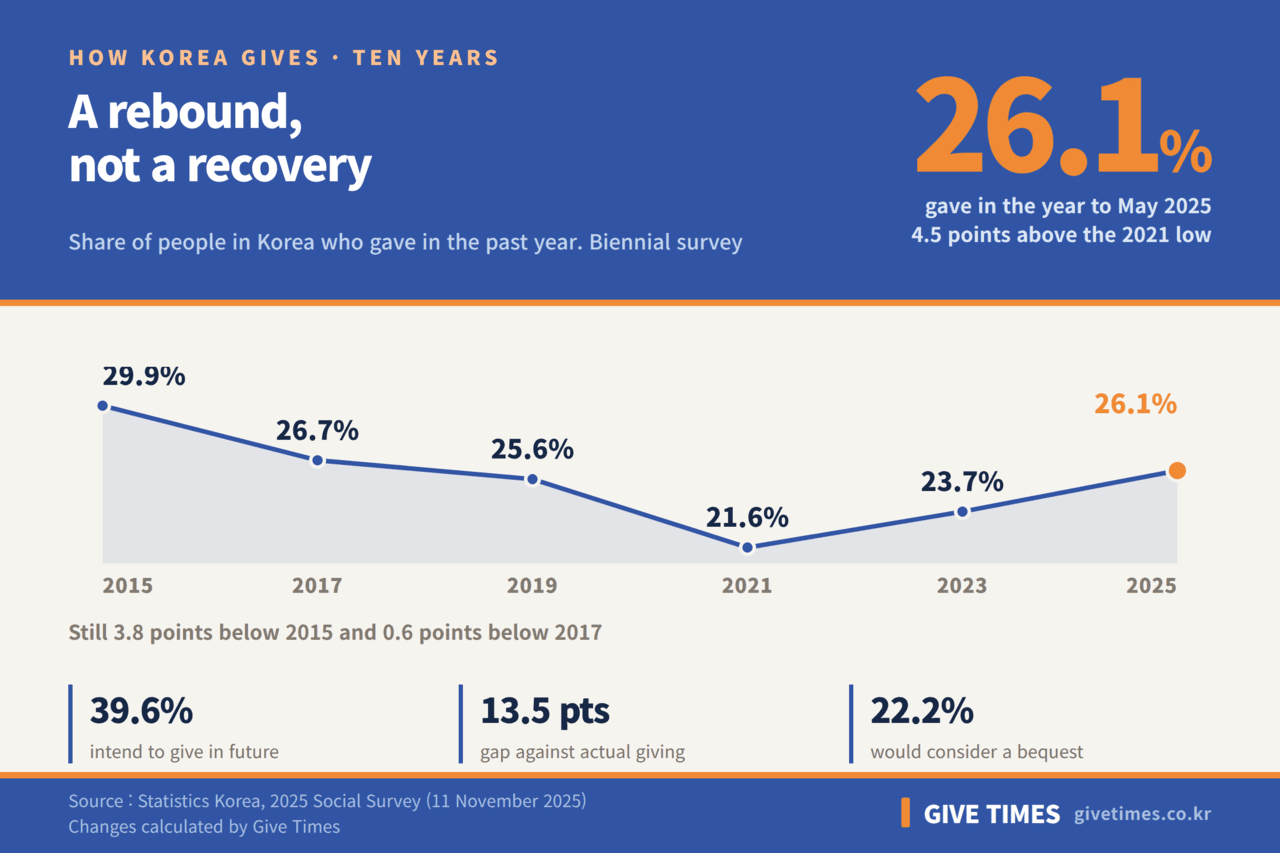
A rebound, not a recovery
Participation ran at 29.9 percent in 2015, 26.7 in 2017, 25.6 in 2019, 21.6 in 2021, 23.7 in 2023 and 26.1 in 2025.
The low point was 2021. Two consecutive surveys have since moved upward, recovering 4.5 percentage points.
Set against 2015, however, the figure is still 3.8 points lower, and it remains 0.6 points below the 26.7 percent of 2017. The direction has turned; the level has not returned.
Cash giving alone was 24.9 percent, up 2.3 points from two years earlier. Working backwards, the 2023 figure was 22.6 percent. That is a derived number, not a published one.
Cash givers gave 9.8 times over the year. Divided into 365 days, that is roughly one gift every 37 days. How much of that is recurring and how much is one-off cannot be separated from the published data.
What new methods would have to change
Four numbers frame the problem: one in four people give, most giving passes through fundraising organisations and religious bodies, the typical rhythm is about once a month, and 13.5 percentage points more people say they intend to give than actually did.
New giving methods have to move at least one of those. Add a route, hold the monthly rhythm, or bring in a first-time giver who has the intention but no habit.
Give Times will take up the third of these separately. Which methods have narrowed that gap is a question that requires performance figures, and those have to be obtained before anything can be said about them.
What is still missing
Give Times has asked the National Data Office for the full list of channel categories and their shares, including what is covered by "and others".
Official confirmation of whether the channel question allows multiple responses is also outstanding. The judgement here rests only on the shares summing to 101.0 percent.
A cross-tabulation of stated intention against actual giving would be needed before the 13.5-point gap can be characterised.
The split between recurring and one-off giving, differences by age group, and amounts given by channel are all still to be obtained.
Sources
Statistics Korea (National Data Office), 2025 Social Survey (announced 11 November 2025). Fieldwork 14 to 29 May 2025 over 16 days; about 19,000 sample households, some 34,000 household members aged 13 and over. Gave in the past year 26.1%, intend to give 39.6%, would consider a bequest 22.2%. Participation trend: 2015 29.9%, 2017 26.7%, 2019 25.6%, 2021 21.6%, 2023 23.7%, 2025 26.1%. Group activity participation 69.2%, volunteering 14.4%.
e-나라지표, Cash Donors (updated 9 January 2026, source: Social Survey, social participation section, various years). Cash giving participation 24.9%, 9.8 gifts per giver per year, up 2.3 percentage points on two years earlier. Channels: fundraising organisations 54.6%, religious bodies 32.0%, direct to recipient 14.4%, and others.
National Data Office press release https://mods.go.kr/board.es?act=view&bid=219&list_no=439196&mid=a10301060300
e-나라지표 https://www.index.go.kr/unity/potal/main/EachDtlPageDetail.do?idx_cd=2693
Give Times calculations
The 13.5-point gap is 39.6% minus 26.1%.
The 4.5-point rebound is 26.1% minus 21.6%; the 3.8-point shortfall against 2015 is 29.9% minus 26.1%; the 0.6-point shortfall against 2017 is 26.7% minus 26.1%.
Cash giving of 22.6% in 2023 is 24.9% minus the reported 2.3-point rise. It is derived, not published.
The interval of about 37 days is 365 divided by 9.8 (37.24).
The channel shares were added only to check the total of 101.0%; the sum is not used in the article.
Limitations of this article
The channel shares are taken from a summary indicator page rather than the survey's own statistical tables, which Give Times has not yet obtained.
The reason the three shares exceed 100 percent has not been confirmed by the issuing agency. The multiple-response reading is Give Times' inference and is described as such.
The article does not claim that online platforms are absent from the classification. What is confirmed is only that the summary lists three channels followed by "and others".
Intention to give and actual giving are separate questions in the same survey. The difference between them is not presented as the number of people who promised and did not deliver.
The 2023 cash giving figure of 22.6% is derived by subtraction and may differ from the published value by rounding.
Amounts given are not covered here. The Social Survey collects participation and frequency; amounts are handled separately.