Raise More Than 10 Million Won in Korea and You Must Register — Fundraising Without It Carries Up to Three Years
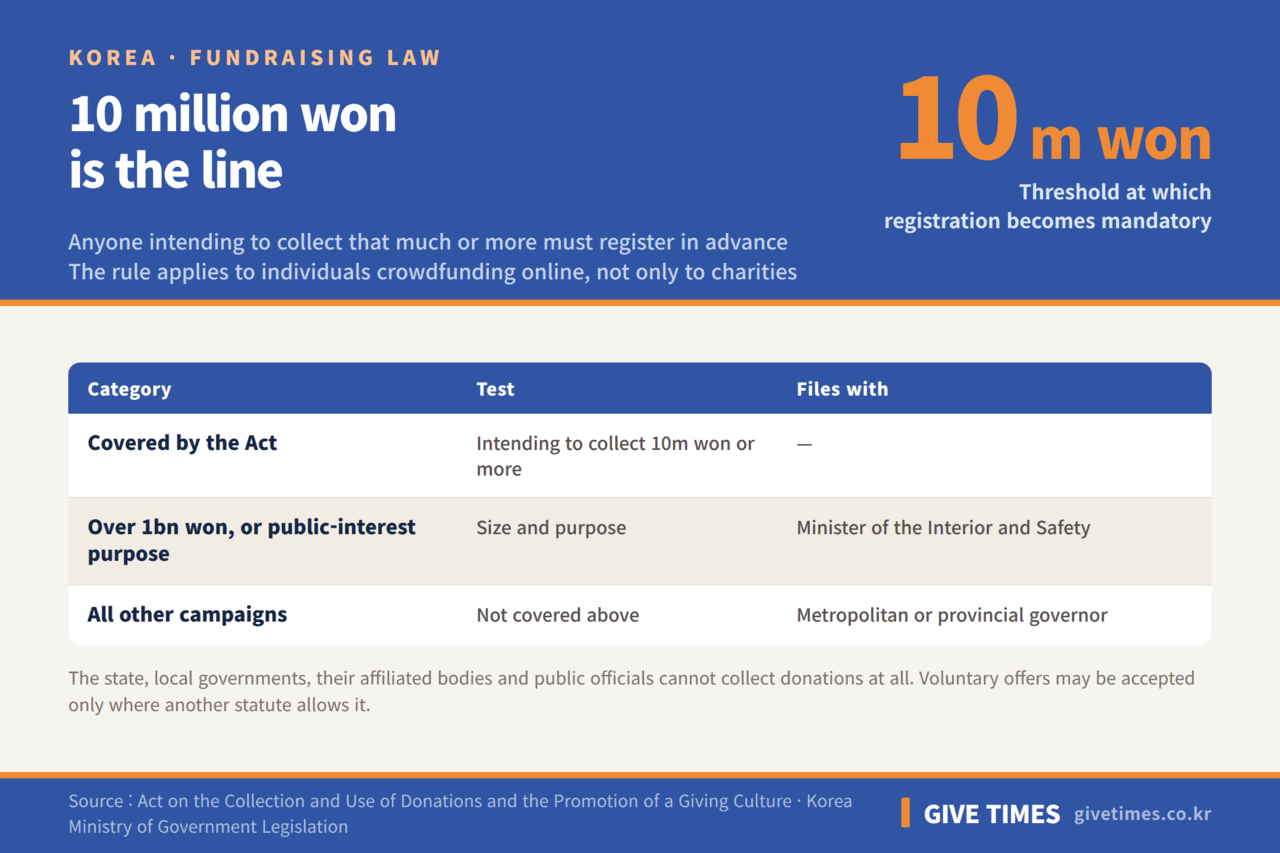
The threshold applies to individuals crowdfunding online, not only to charities
Government bodies and public officials are barred from fundraising altogether
Raising money for a cause in South Korea is not an unregulated act. Past a set amount, registration is mandatory, and collecting without it is a criminal offence.
The line is 10 million won, roughly 7,000 US dollars. Anyone intending to collect that much or more in donations must register beforehand under the Act on the Collection and Use of Donations and the Promotion of a Giving Culture.
The rule catches more people than its drafters may have had in mind. An individual opening a bank account after a disaster, a community organising online for a neighbour in difficulty, a fan group pooling money for a cause — all fall under the same threshold.
Ten million won is the line
Anyone intending to collect 10 million won or more in donations must register a collection and use plan in advance.
Where the filing goes depends on the size and purpose of the campaign. If the target exceeds 1 billion won, or if the campaign serves a public-interest purpose, it is filed with the Minister of the Interior and Safety. Everything else is filed with the metropolitan or provincial governor for the area where the collector resides.
The threshold turns on the amount intended to be collected, not on the amount eventually raised or the figure written on a poster. A campaign that sets out to raise more than 10 million won is covered from the start.
Three years, or thirty million won
Collecting donations without registering carries up to three years' imprisonment or a fine of up to 30 million won.
Compelling someone to donate carries the same penalty. So does publishing false accounts of a campaign's progress or use, or failing to file the required report.
Failing to keep proper books carries up to one year's imprisonment or a fine of up to 10 million won.
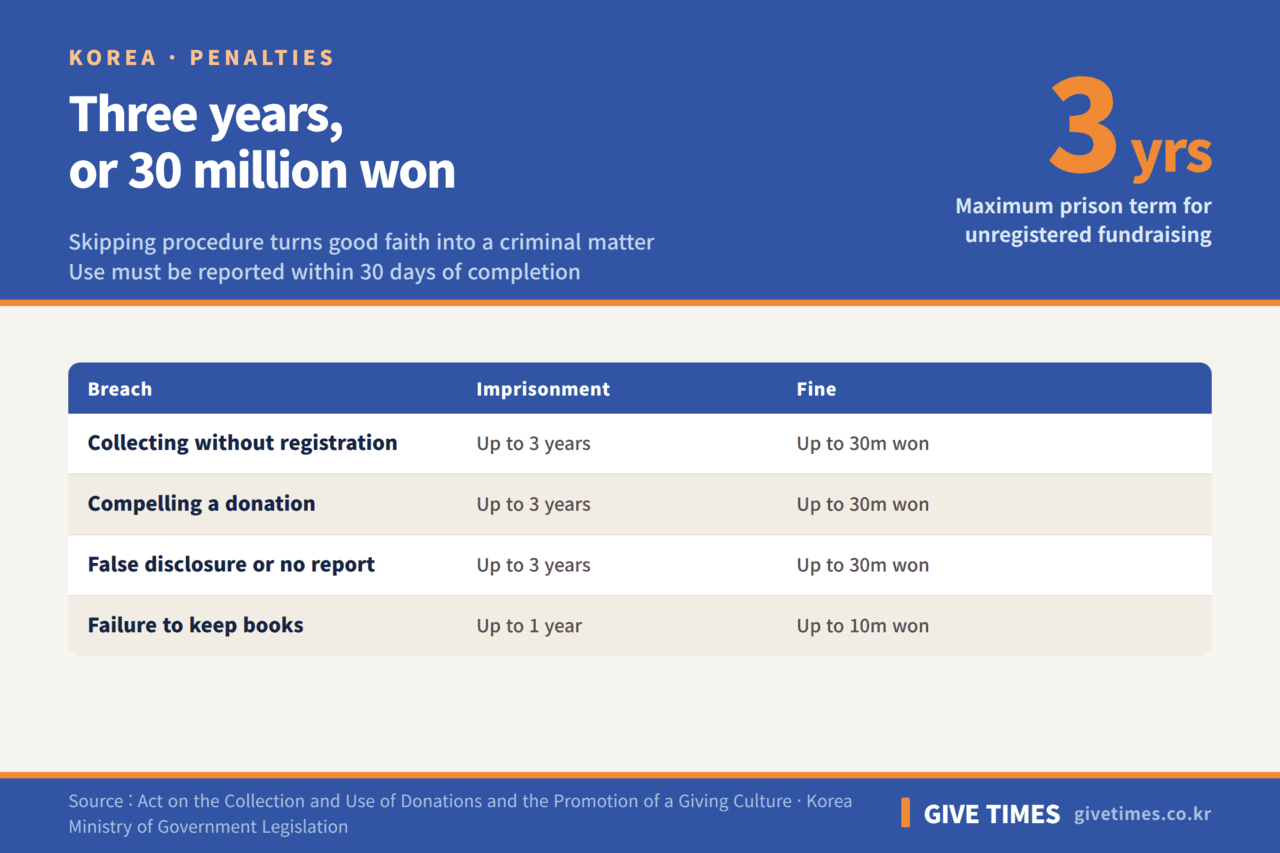
These are not nominal sanctions. A campaign begun in good faith can become a criminal matter if the procedure is skipped.
Collecting is only the first half
Registration is not the end of the obligation.
When a campaign is suspended or completed, the collector must announce that without delay and post it on a website for at least 30 days. Once the money has been spent, a report detailing its use must be filed with the registering authority within 30 days of completion.
For donors, this is the part that matters most. It is the mechanism by which what happened to the money becomes checkable. A registered campaign owes an account of its spending; the absence of one is itself worth asking about.
The state cannot pass the hat
The same Act bars the national government, local governments, their affiliated bodies and public officials from collecting donations.
Even voluntarily offered money and goods cannot be accepted unless another statute provides for it. Three exceptions exist: acceptance approved by a donation review committee, simple receipt and transfer at the request of a registered collector, and acceptance by a corporation or organisation not under the substantive direction of a government head.
The provision keeps administrative bodies out of fundraising. It is why a local authority asking companies for goods can become a legal question rather than a routine one.
What is not established here
Enforcement figures — how many unregistered campaigns are detected and what happens to them — were not available in published sources.
The share of collected funds that may be spent on the cost of collecting is set by presidential decree. Give Times did not obtain the specific ratio and has not stated one.
Annual registration counts and total target amounts are published quarterly by the Ministry of the Interior and Safety, but the underlying files were not obtained for this article.
SOURCES
Act on the Collection and Use of Donations and the Promotion of a Giving Culture. Registration threshold of 10 million won; filing with the Minister of the Interior and Safety where the target exceeds 1 billion won or the purpose is public interest, otherwise with the metropolitan or provincial governor for the collector's address; announcement and website posting for at least 30 days on suspension or completion; report on use within 30 days of completion; up to three years' imprisonment or a fine of up to 30 million won for unregistered collection, for compelling donations, and for false disclosure or failure to report; up to one year or 10 million won for failing to keep books; prohibition on collection by the state, local governments, affiliated bodies and public officials, with three exceptions.
Korea Ministry of Government Legislation, Easy Law https://www.easylaw.go.kr/CSP/CnpClsMain.laf?popMenu=ov&csmSeq=703&ccfNo=3&cciNo=1&cnpClsNo=1
Ministry of the Interior and Safety, guidance on donation collection registration and quarterly registration status
https://www.mois.go.kr/frt/bbs/type001/commonSelectBoardArticle.do?bbsId=BBSMSTR_000000000057&nttId=73568
LIMITATIONS
This article is based on a summary of the statute. Whether the Act applies to a given case depends on the collector and the method, and anyone planning a campaign should confirm with the registering authority or a lawyer.
The permitted ratio for collection costs was not obtained and is not stated.
Enforcement statistics were not available.
The date on which the Act's title was amended was not established in this reporting.
Won-to-dollar conversions are approximate and vary with the exchange rate.