Korea Moves to Reward Leaving Money Behind — A 10% Tax Cut for Legacy Giving
A cross-party bill filed in January 2026 would cut inheritance tax by 10% for estates giving more than 10% of their value to public causes
It follows the UK's Legacy10, introduced in 2011
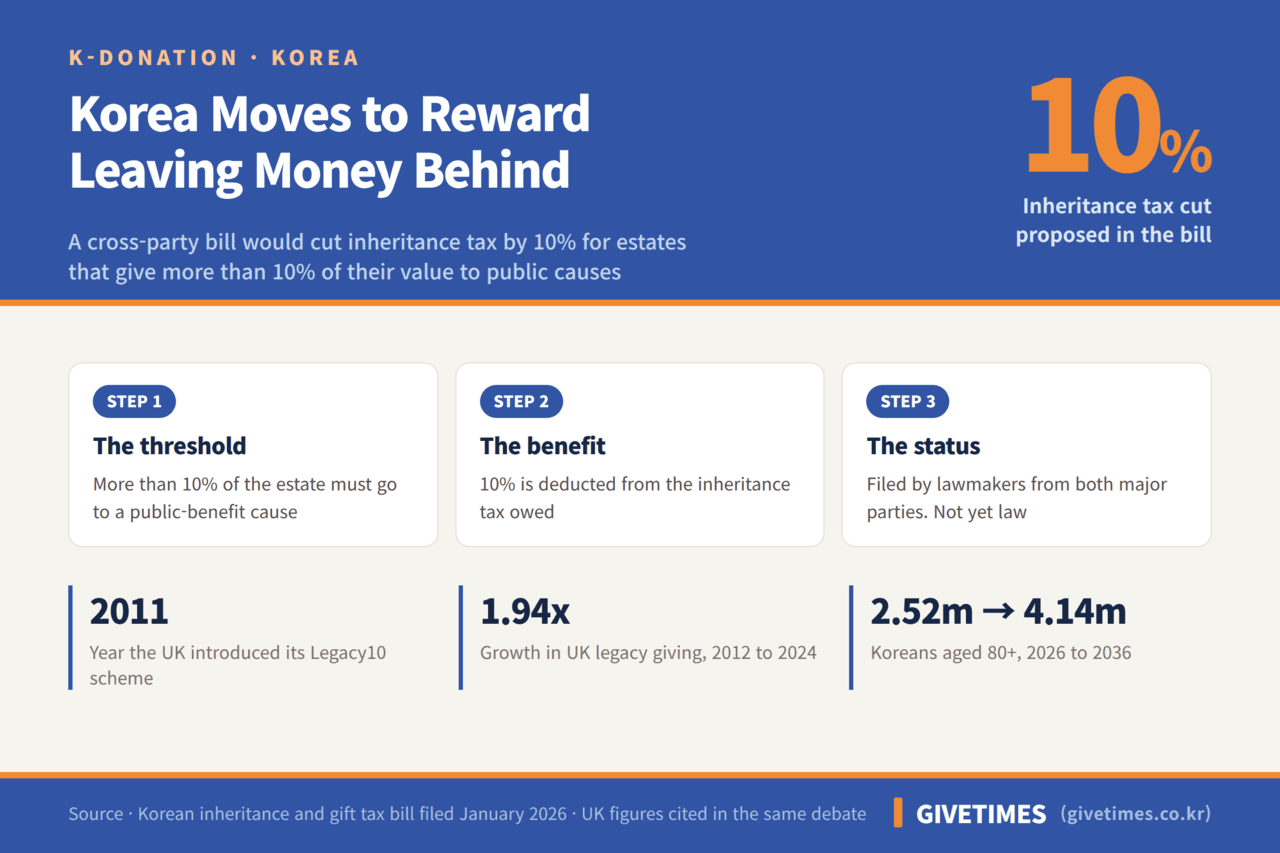
Lawmakers from both of South Korea's major parties have filed a bill that would cut inheritance tax by 10% for estates leaving more than a tenth of their value to public causes.
What the bill does
The proposal amends Korea's Inheritance Tax and Gift Tax Act. If more than 10% of an estate goes to a public-benefit purpose, 10% is deducted from the inheritance tax owed.
It was filed in January 2026 by Chung Tae-ho of the Democratic Party and Park Soo-young of the People Power Party, the ruling and opposition floor managers on the National Assembly's finance and economic planning committee. A legislative forum was held at the Assembly on 21 January.
It is not law. The bill has been filed and must still pass the Assembly.
Why a cross-party filing matters
Tax legislation in Korea usually splits along party lines. Inheritance tax in particular has been one of the more contested areas of Korean fiscal policy.
That the two committee floor managers filed this together is the notable part. It suggests legacy giving is being treated as a demographic question rather than a redistributive one.
The demographics behind it
Korea's population aged 80 and over is projected to grow from 2.52 million in 2026 to 4.14 million in 2036 — a 1.64-fold increase, or 1.62 million more people, in a decade.
Among single-person households, 19.8% are aged 70 or over.
The implication is a growing volume of estates with no heir, or with an owner who has no particular wish to pass wealth on. Without a legacy giving route, that money reverts to the state or sits unclaimed.
The model is British
Korea's bill draws on the UK's Legacy10, introduced in 2011, which reduces the inheritance tax rate for estates giving a set share to charity.
Figures presented at the Korean legislative forum, cited to Professor Park Hoon of the University of Seoul, put UK legacy giving at roughly 4.6 trillion won in 2012 and roughly 8.9 trillion won in 2024 — a 1.94-fold increase over twelve years. These are won conversions and move with the exchange rate.
That increase should not be read as pure policy effect. Twelve years is long enough for asset prices, inflation, death rates and estate sizes to shift on their own. A controlled before-and-after analysis was not available for this article.
What Korea would still need
Two conditions sit underneath the British numbers, and neither is a tax rule.
The first is information. The UK has a long-established charity registration and accounts regime, so a donor deciding where to leave money has something to read. Korea has this too — the National Tax Service publishes annual filings for registered public interest corporations — though it is less familiar to the general public.
The second is wills. A legacy giving incentive does nothing for an estate with no valid will. Will-writing rates in Korea are understood to be lower than in the UK, and Korean civil law sets strict formal requirements: a will that misses one of them is void.
A tax deduction reaches only those who have already written a will naming a recipient. Widening that group is a separate problem from tax design.
Open questions
The bill's detailed provisions — the deduction ceiling, the definition of a qualifying public-benefit purpose, the effective date — were not available for this article, and they will determine how much the measure actually does.
Korea has no published baseline figure for current legacy giving. Without one, the effect of the law cannot be measured later even if it passes.
Sources
· Amendment to the Inheritance Tax and Gift Tax Act, filed January 2026 by
Chung Tae-ho (Democratic Party) and Park Soo-young (People Power Party),
floor managers on the National Assembly finance and economic planning committee.
Legislative forum held at the National Assembly on 21 January 2026
· UK Legacy10 introduced 2011. UK legacy giving figures of approximately
4.6 trillion won (2012) and 8.9 trillion won (2024) were presented at that forum,
cited to Professor Park Hoon, University of Seoul
· Population aged 80+: 2.52 million (2026) to 4.14 million (2036), projected.
Share of single-person households aged 70+: 19.8%
Calculations by GIVETIMES
· 8.9 ÷ 4.6 = 1.94 — growth in UK legacy giving, 2012 to 2024
· 4.14 ÷ 2.52 = 1.64 — growth in Koreans aged 80+, 2026 to 2036
· 4.14m − 2.52m = 1.62 million more people over the decade
Limits of these figures
The bill is filed, not enacted. Its detailed provisions were not available.
UK figures are won conversions of a figure presented at a Korean forum, not drawn from UK source data. The sterling growth rate may differ.
No controlled analysis separating policy effect from asset price and inflation growth was available.
Will-writing rates in Korea and the UK have not been compared here on a common basis.