What Is "Geunyang Deurim"? Korea's No-Paperwork Food Support, Explained
Walk into a participating site, take about 20,000 won of food and daily essentials, and leave
There is no income proof, no application form and no waiting for approval
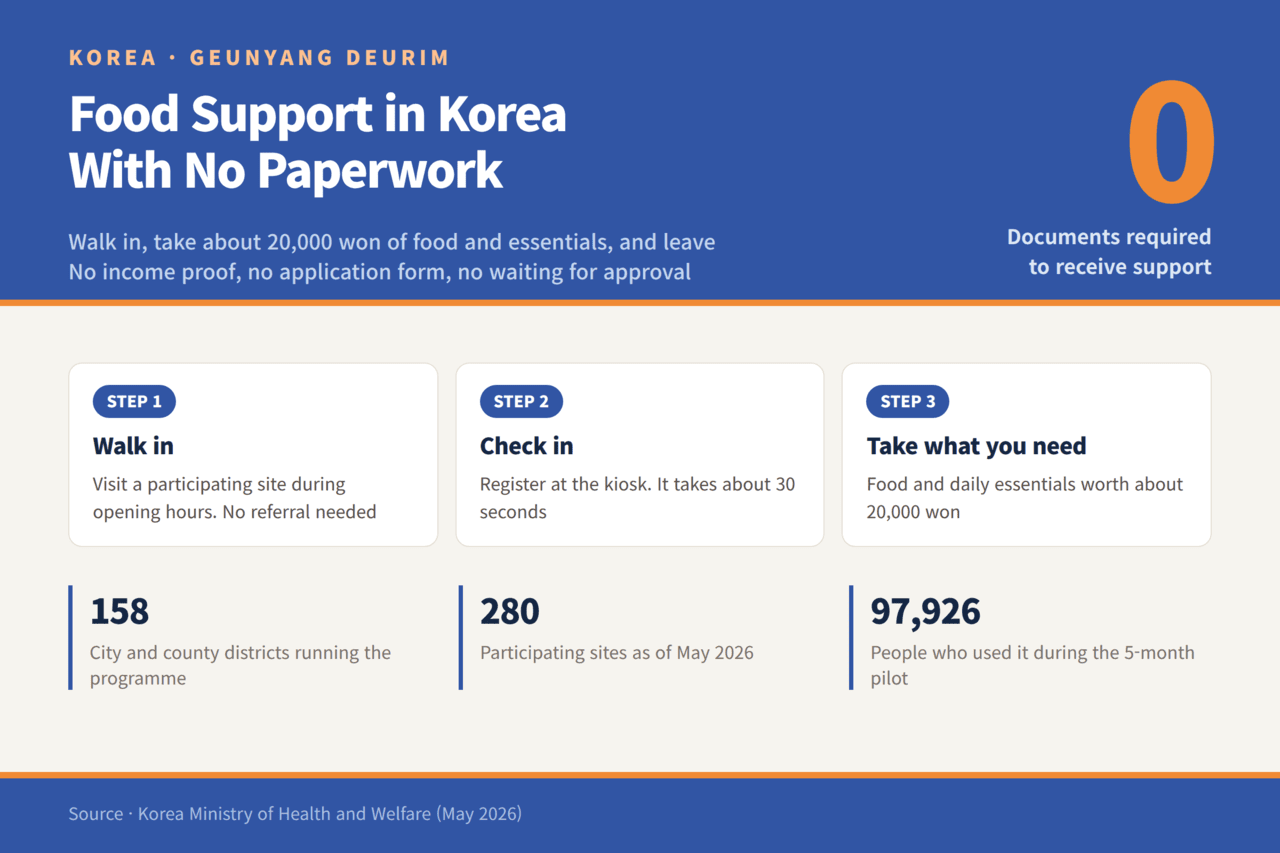
Geunyang Deurim is a Korean government programme that gives about 20,000 won of food and daily essentials to anyone who walks in, with no documents required.
The name means "just giving"
"그냥드림" (geunyang deurim) translates roughly as "just giving" — giving without asking why.
That phrasing is the policy. Most welfare programmes start by asking you to prove you need help. This one does not. You do not show income records, you do not fill in an application, and you do not wait for a decision.
The Ministry of Health and Welfare began a pilot in December 2025 and expanded the programme nationwide on 18 May 2026, across 158 city and county districts and 280 sites. The stated goal is 229 districts and more than 300 sites within the year.
How it works
Three steps, and the whole visit takes minutes.
You walk in during opening hours. No referral, no appointment.
You check in at a kiosk. This takes about 30 seconds. In most sites you are not asked for your name.
You take food and daily essentials worth about 20,000 won.
That is the entire process. There is no interview and no follow-up requirement.
Why a country would design it this way
The reasoning behind removing the paperwork is worth understanding, because it is the opposite of how most safety nets are built.
Korea has had repeated cases where households in severe hardship never applied for the support they were entitled to. Some did not know the programme existed. Some knew but could not face the process. Some fell just outside the eligibility line.
A programme with no entry requirement reaches those households, because there is nothing to fail.
The trade-off is that you learn very little about who you helped. During the five-month pilot, 97,926 people used the service. Of those, 10,255 were connected to a welfare centre, and 1,553 households were newly identified as being in crisis — households the welfare system had not previously recorded.
That is 1.6% of users — a figure the programme's operators are now working to raise, which is why a voluntary self-assessment step was added when it moved from pilot to full operation.
What this is not
Two clarifications matter.
It is not a general grocery benefit. The support is a one-off provision of food and essentials at the site, not a recurring allowance or a cash transfer.
It is not the same as Korea's Food Bank. Food Bank and Food Market serve people who have already been assessed and registered, and they provide ongoing support. Geunyang Deurim sits earlier in the sequence: it meets people before any assessment has happened.
How sites are being designed
The national programme sets the rules; each district decides what the space looks like.
One approach now being tried is to add a place to sit. A site that opened in Ansan on 21 August 2026, at the Bugok Community Welfare Centre, puts three things in one room: the goods counter, a self-service kiosk that takes about 30 seconds, and a lounge with tea and a small-group programme for people living alone.
The reasoning is that a counter you collect from is a place you leave. A room you can sit in is a place you return to, and returning is what makes any follow-up possible.
That site also does something small and clever with paperwork. The receipt for the goods doubles as a name badge, printed with the visitor's name, a "mood weather" they picked themselves from five options, and a short message of encouragement. A person arriving alone has a reason to be spoken to, and the operator gets a record of how that person was feeling — without having asked them to explain anything.
For foreign residents in Korea
If you live in Korea and are wondering whether this applies to you, the honest answer is that eligibility rules for foreign residents are set locally and are not stated uniformly in the national materials.
The programme's design does not involve checking documents at the point of use. What that means in practice for a foreign resident at a specific site is best confirmed with that district office.
The general route for welfare questions in Korea is the Ministry of Health and Welfare call centre on 129. Interpretation support is available for some languages. Your local 시·군·구청 (city, county or district office) can tell you which sites near you are participating.
What other countries might take from it
The transferable idea is not the food. It is the sequencing.
Most systems ask people to prove need, then help. This one helps, then — only if the person wants it — offers a route into the system. The pilot's 1,553 newly identified households are the argument for that order.
The open question, which Korea is still working on, is how to learn enough from a no-questions-asked encounter to actually follow up. The ministry introduced a voluntary self-assessment checklist when the programme moved from pilot to full operation. That is the part worth watching.
Sources
· Korea Ministry of Health and Welfare — Geunyang Deurim nationwide rollout, 18 May 2026
158 city and county districts, 280 sites; target of 229 districts and 300+ sites within the year
Support of approximately 20,000 won per person in food and daily essentials
· Pilot results as of 30 April 2026 — 97,926 users; 10,255 referred to welfare centres;
1,553 households newly identified as in crisis
· A voluntary self-assessment checklist was introduced with the full rollout
Calculations
· 1,553 ÷ 97,926 = 1.6% — newly identified crisis households as a share of users
· 10,255 ÷ 97,926 = 10.5% — users referred to a welfare centre
Limits of these figures
User counts are visits by headcount while identified households are counted per household, so the ratio is indicative rather than exact.
Eligibility for foreign residents is not addressed uniformly in national materials. This article does not state that foreign residents are or are not eligible; confirm with the local district office.
Operating hours, stock and site rules vary by location.