Korea Publishes Every Charity's Books — And Anyone Can Read Them for Free
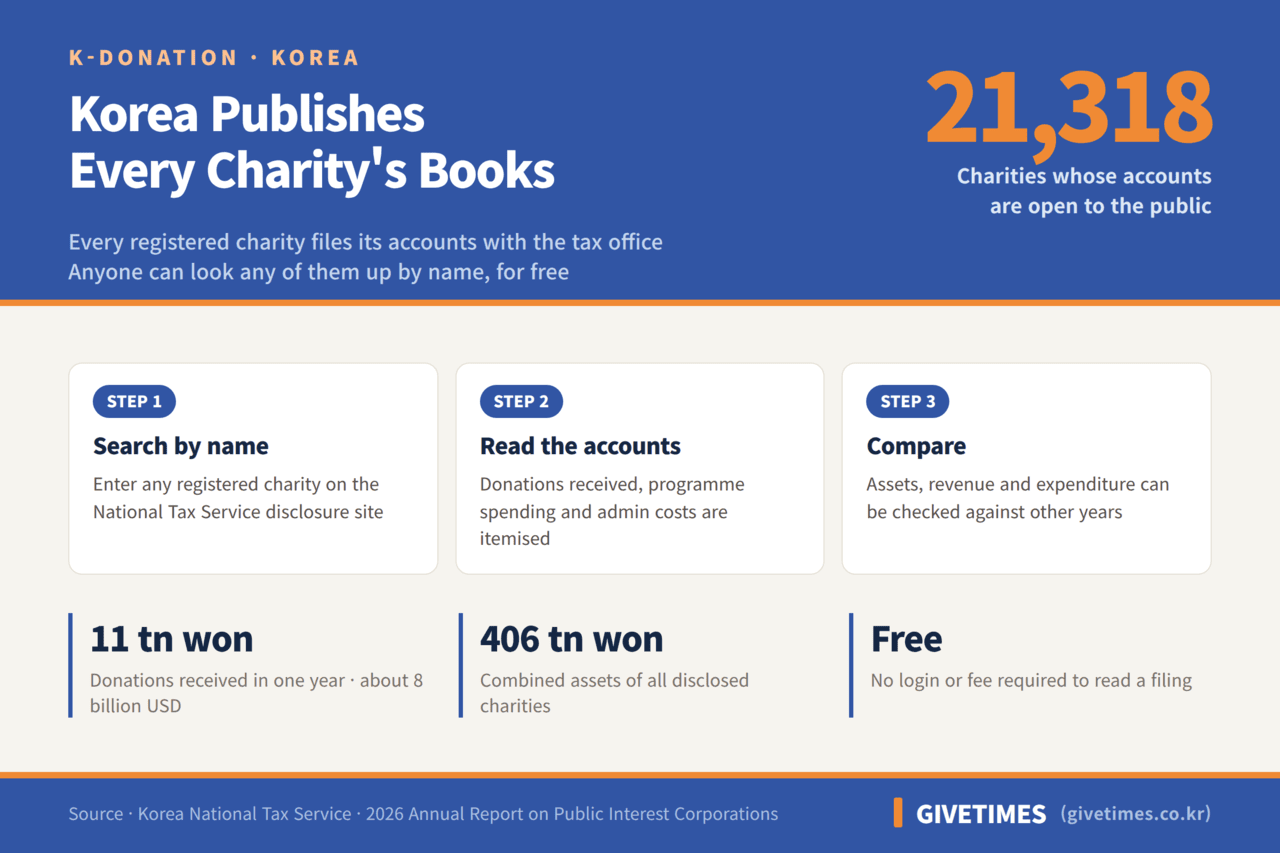
21,318 registered charities file annual accounts with the National Tax Service
The filings show donations received, programme spending and administrative costs, itemised
The most common reason people give for not donating is not stinginess. It is not knowing where the money goes. Korea answered that with a database.
What is actually published
Korea requires registered public interest corporations — the legal category that covers most charities, foundations and welfare organisations — to file annual accounts with the National Tax Service. Those filings are then published.
For the most recent reporting year, 21,318 organisations filed. Their combined assets came to 406 trillion won. Donations they received in one year came to 11 trillion won, roughly 8 billion US dollars.
The filings are not summaries. They itemise donations received, how much was spent on programmes, how much on administration and fundraising, and what the organisation owns.
There is no login, no fee and no application. You type the organisation's name and read.
Why publishing beats promising
Most countries ask charities to be transparent. Fewer countries make the underlying documents public by default.
The difference matters because of who does the checking. If transparency depends on each organisation choosing to publish, the ones with something to hide simply publish less. If filing is mandatory and the filings are open, a journalist, a donor or a rival organisation can check any of them without permission.
That is what makes the number usable. When a Korean newspaper reports that the top 15 recipients took 4 trillion won of the 11 trillion — 38% of all donations — that figure is not a leak or an estimate. It is arithmetic on public filings, and any reader can repeat it.
It also cuts both ways
An open system does not only produce reassuring numbers.
The same filings show that assets are heavily concentrated. Charities holding 1 trillion won or more in assets — 473 of them, 2.2% of the total — hold 78% of all charity assets in the country. The remaining 20,845 organisations share the rest.
Some of that is structural: universities and hospitals are registered in this category, and their land and buildings count as assets. But the concentration is visible precisely because the data is open.
A system that only surfaced good news would not be worth much. The value is that the awkward numbers come out through the same pipe.
What a country would need to copy this
Three things, in order.
First, a single legal category that captures the organisations you want covered, with filing as a condition of the tax benefit rather than a voluntary code.
Second, a standard filing format. The reason Korean figures can be aggregated at all is that every organisation reports the same line items. Free-form annual reports cannot be added up.
Third, publication by default, with no gatekeeping. A database that requires a request, a login or a fee is a database most people never open.
The tax authority is a natural host for this, because it already receives the filings for tax purposes. Building a separate charity regulator is not the only route.
What to check before citing this
One, the figures here come from the 2026 annual report on public interest corporations, based on 2025 filings. Both years appear in the source; the filing year is what the figures describe.
Two, disclosure applies to organisations above a size threshold. Small local groups are not in the database, so the totals understate the sector.
Three, "assets" in this system includes land and buildings used to run schools and hospitals. Asset concentration is not the same as donation concentration, and the two should not be read as one.
Four, the dollar equivalents in this article are approximate. The won figures are the official ones.
Sources
· Korea National Tax Service (국세청), 2026 Annual Report on Public Interest Corporations,
based on 2025 annual filings
— 21,318 organisations filing; combined assets 406 trillion won; donations received 11 trillion won
— Top 15 recipients 4 trillion won, 38% of all donations
— 473 organisations with assets of 1 trillion won or more hold 78% of total assets
· The disclosure requirement is set out in Korea's Inheritance Tax and Gift Tax Act.
Filings are published on the National Tax Service Hometax disclosure system.
Calculations by GIVETIMES
· 473 ÷ 21,318 = 2.2% — share of organisations holding 78% of assets
· 21,318 − 473 = 20,845 — remaining organisations
· 4 ÷ 11 = 36.4% — the source reports 38%; the gap comes from rounding to whole trillions
· 15 ÷ 21,318 = 0.07% — share of organisations receiving 38% of donations
Limits of these figures
Disclosure applies only above a size threshold, so the sector totals are understated.
Asset figures include operating property of universities and hospitals registered in this category. Asset concentration should not be read as donation concentration.
The list of the top 15 recipients was not obtained for this article.