Korea Measures Charity in Degrees: The Love Temperature Tower Hit a Record 113.9°
Every 1% of the national fundraising goal raises the thermometer by one degree
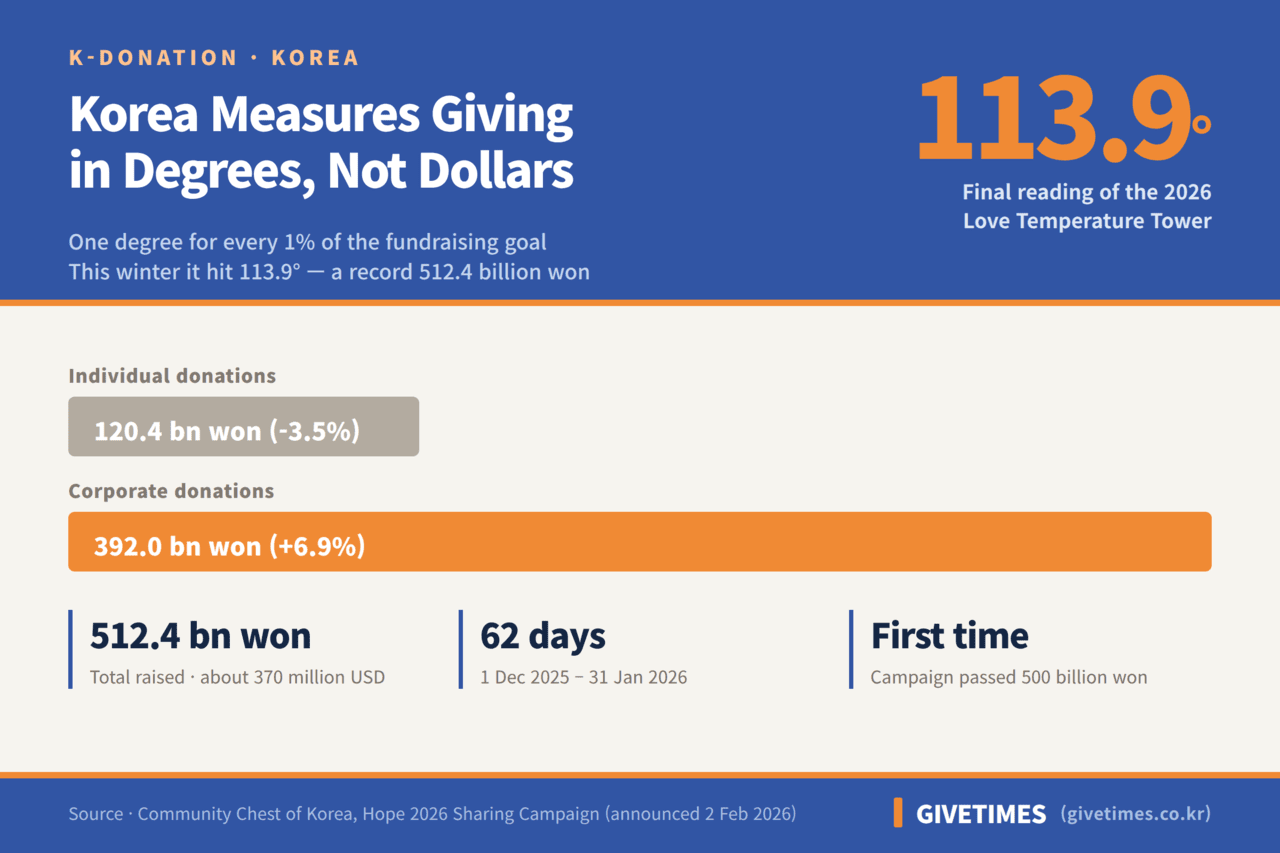
The 2026 winter campaign closed at 512.4 billion won, the first time it passed 500 billion
Most countries publish a fundraising total. Korea publishes a temperature.
A thermometer instead of a leaderboard
Every December a large thermometer goes up in Gwanghwamun Square in central Seoul. It is called the Love Temperature Tower, and it does one thing: it converts the nation's winter giving into degrees.
The rule is simple. Every 1% of the campaign's fundraising goal raises the reading by one degree. Reach the full target and the tower reads 100 degrees.
The 2026 campaign, run by the Community Chest of Korea from 1 December 2025 to 31 January 2026, ended at 113.9 degrees. That is 13.9% above the goal.
Why a thermometer works
The design choice is worth noticing, because it solves a problem every fundraiser has.
A running total in currency is hard to feel. Most people cannot tell whether 300 billion won in December is ahead of schedule or behind it. A temperature answers that instantly. One hundred is the finish line, and everyone already knows what a thermometer looks like when it is climbing.
It also removes the comparison that makes donors uncomfortable. The tower does not show who gave, or how much any one person gave. It shows only whether the country, collectively, is on track. A donor giving 10,000 won and a company giving 10 billion won move the same needle in the same direction.
The tower is updated publicly through the campaign, which turns a two-month fundraising drive into something closer to a countdown that the whole country can watch.
A record year, with one number moving the wrong way
The 2026 campaign raised 512.4 billion won, about 370 million US dollars. It was the first time the winter campaign passed 500 billion won in its history.
Underneath that record, the two halves of the total moved in opposite directions.
Corporate donations came to 392.0 billion won, up 6.9% from the previous campaign.
Individual donations came to 120.4 billion won, down 3.5%.
So the record was set by companies, not by households. That divergence is the more important finding in the data. A campaign that grows on corporate giving while individual participation shrinks becomes more dependent on fewer, larger decisions each year.
This is not unique to Korea. But Korea's numbers are unusually visible, because the thermometer publishes progress in public every day of the campaign, and the final breakdown is announced together with it.
What other countries can take from this
Three things travel well.
First, a single public metric that anyone can read at a glance. The unit matters less than the fact that it is one number, updated openly, with a clearly marked finish line.
Second, a fixed season. The Korean campaign runs the same two months every year. Donors know when it is coming, and organisations plan around it instead of competing for attention all year.
Third, publishing the composition of the total, not just the total. Korea reports corporate and individual giving separately. That is what made it possible to see that a record year was also a year in which household giving fell.
What to check for yourself
For readers who want to verify or reuse these figures.
One, the campaign figures are published by the Community Chest of Korea, the national fundraising organisation that runs the Hope Sharing Campaign each winter. The final 2026 result was announced on 2 February 2026.
Two, the dollar conversion in this article is approximate and depends on the exchange rate used. The won figures are the official ones. For any citation, use the won amounts.
Three, the "temperature" is a communication device, not a financial measure. It expresses progress against a goal that the organisation sets in advance. A higher temperature in one year does not by itself mean more money was raised than in another year, because the goal can change.
Four, if you are designing a similar campaign, the transferable part is the mechanism, not the thermometer. What makes it work is a pre-announced goal, a public progress indicator, a fixed season, and an honest breakdown at the end.
Sources
· Community Chest of Korea (사랑의열매 사회복지공동모금회), Hope 2026 Sharing Campaign final results, announced 2 February 2026
— Total 512.4 billion won; corporate 392.0 billion won (+6.9%); individual 120.4 billion won (−3.5%)
— Final reading 113.9 degrees; campaign period 1 December 2025 – 31 January 2026 (62 days)
· The Love Temperature Tower conversion rule (one degree per 1% of the fundraising goal) is set by the Community Chest of Korea
Calculations by GIVETIMES
· 392.0 + 120.4 = 512.4 billion won (components sum to the announced total)
· 392.0 ÷ 512.4 = 76.5% of the total came from corporate donations
· 113.9 degrees − 100 = 13.9% above the announced goal
· Approx. 370 million USD — converted at roughly 1,385 won to the dollar. Rate-dependent; cite the won figure
Limits of these figures
The fundraising goal amount itself is not published alongside the temperature, so the degrees cannot be converted back into a target figure from this data alone.
Whether the fall in individual giving reflects fewer donors or smaller average gifts is not broken out. Year-by-year individual and corporate figures for earlier campaigns are also not published together with the final result.